

1. What is a SHA-256 Hash Generator and Why is it Indispensable in 2026?
A cryptographically secure SHA-256 Hash Generator is one of the most fundamental security instruments in modern computer science, distributed cloud computing, and digital trust architectures. Every single day, trillions of digital operations—from verifying operating system ISO downloads and validating Git commit histories to anchoring Bitcoin blockchain transactions and authenticating SSL/TLS certificates—rely entirely on the mathematical immutability of the SHA-256 algorithm. Without a reliable, deterministic SHA-256 Hash Generator, verifying whether a 50-gigabyte enterprise database backup or a sensitive configuration file has been corrupted or maliciously intercepted in transit would be computationally impractical.
The acronym SHA stands for Secure Hash Algorithm, and SHA-256 represents the flagship 256-bit member of the Secure Hash Algorithm 2 (SHA-2) cryptographic family, formally standardized by the United States National Institute of Standards and Technology under NIST FIPS PUB 180-4 and documented internationally in IETF RFC 6234. Unlike symmetric or asymmetric encryption algorithms (such as AES-256 or RSA) that transform plaintext into ciphertext that can later be decrypted back into its original form using a decryption key, a cryptographic hash function produced by a SHA-256 Hash Generator is strictly a one-way mathematical transformation. It maps input data of arbitrary length into a fixed-size 256-bit (32-byte) digital fingerprint, conventionally rendered as a 64-character hexadecimal string.
In 2026, cybersecurity threats such as automated software supply-chain poisoning, man-in-the-middle packet tampering, and unauthorized firmware manipulation make cryptographic verification indispensable. Whether a software developer is verifying package checksums from npm, Docker Hub, or GitHub releases, or a security auditor is validating immutable audit logs, deploying an online SHA-256 Hash Generator allows instant, zero-latency verification of arbitrary strings, tokens, and payloads directly within the browser without installing complex command-line tooling.
Through our dedicated in-browser SHA-256 Hash Generator Tool, software engineers, DevOps specialists, and security researchers can compute high-performance cryptographic digests instantly. Because our utility executes 100% within the local browser sandbox via the native Web Crypto API, sensitive passwords, API keys, and corporate strings are never exposed over third-party networks or stored on external cloud servers.
2. Cryptographic Anatomy: Inside NIST FIPS 180-4 and Merkle-Damgård Construction
To understand the impenetrable resilience of a SHA-256 Hash Generator, one must explore its foundational mathematical architecture. Published originally by NIST in 2002 to supersede the aging SHA-1 and MD5 algorithms, SHA-256 is built upon the time-tested Merkle-Damgård iterative construction, designed to preserve collision resistance across data streams of any size.
The Five Mandatory Properties of Cryptographic Hash Functions
Not every mathematical hashing algorithm qualifies as a secure cryptographic primitive. A modern SHA-256 Hash Generator strictly satisfies five vital mathematical criteria established by modern cryptographers:
- Deterministic Consistency: Given the identical binary input sequence, the algorithm will invariably compute the exact same 64-character hexadecimal digest every single time, across any operating system or hardware architecture.
- High-Speed Computation: The mathematical hashing routine computes digests at blistering speeds, processing hundreds of megabytes per second using hardware-accelerated CPU instructions (such as Intel SHA Extensions and ARMv8 Cryptography Extensions).
- Preimage Resistance (One-Way Property): Given an arbitrary 256-bit hash output
H, it is computationally impossible to reverse-engineer or derive the original input messageMsuch thathash(M) = H. - Second Preimage Resistance (Weak Collision Resistance): Given an input message
M1, it is computationally infeasible to find a different messageM2such thathash(M1) = hash(M2). - Collision Resistance (Strong Collision Resistance): It is mathematically impossible within realistic thermodynamic and cosmological limits to locate any two distinct messages anywhere in the universe that yield the exact same 256-bit output digest.
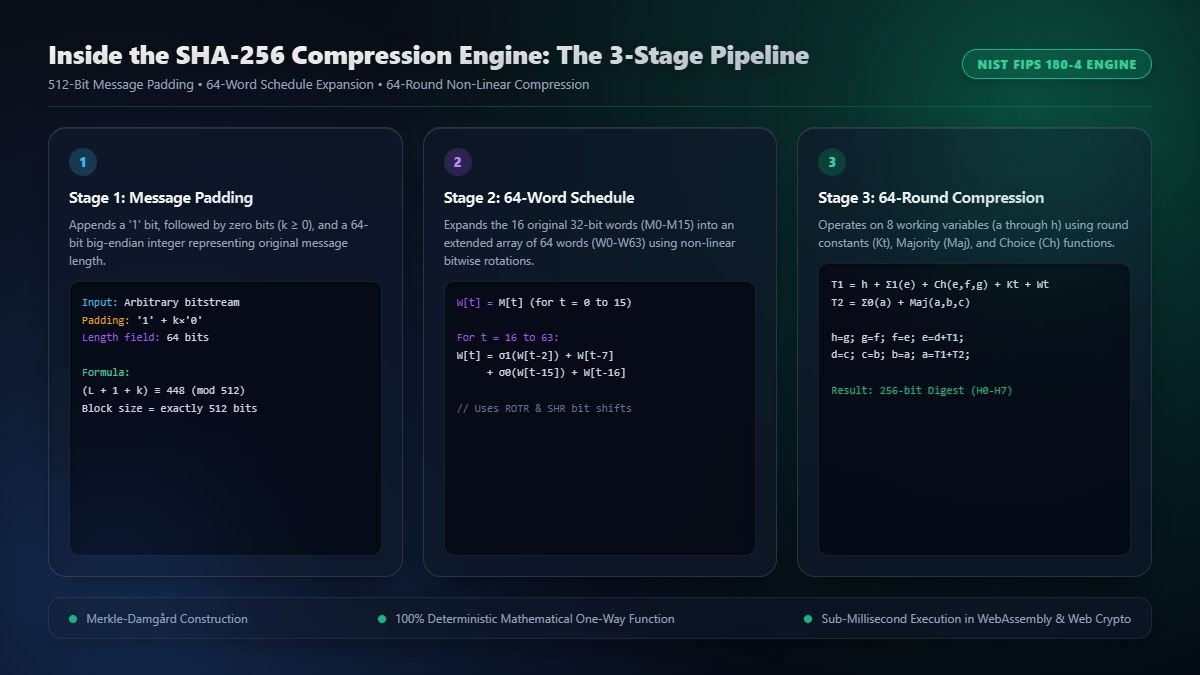
Message Padding and 512-Bit Block Partitioning
Before the compression cycle begins within a SHA-256 Hash Generator, the input data stream must be padded so that its total bit length is an exact multiple of 512 bits (64 bytes). The padding procedure implemented inside our SHA-256 Hash Generator follows a strict three-step protocol:
- A single binary
1bit (hexadecimal0x80) is appended immediately to the end of the unpadded message. - A variable sequence of
kzero bits (0x00) is appended until the total length is congruent to 448 modulo 512 bits (leaving exactly 64 bits remaining in the final block). - The original message length, expressed as a 64-bit big-endian unsigned integer, is appended to the final 64 bits, completing the 512-bit block.
This padding scheme guarantees that messages of differing lengths can never produce identical padded blocks, entirely preventing length-extension alignment collisions.
3. The 64-Round Compression Cycle: Message Scheduling and Non-Linear Functions
Once the message is partitioned into sequential 512-bit blocks, each block is fed through the core cryptographic engine of the SHA-256 Hash Generator: the 64-round compression function. This mathematical meat-grinder ensures that every input bit thoroughly permeates and scrambles every single bit of the final output state.
Initial Hash Values and Fractional Cube Roots
In our SHA-256 Hash Generator, the internal state consists of eight 32-bit working registers labeled A, B, C, D, E, F, G, H, totaling 256 bits. At the beginning of the hashing process, these registers are initialized with eight fixed hexadecimal constants (H0 through H7). To eliminate any suspicion of hidden cryptographic backdoors or algorithmic bias, these constants were derived directly from the fractional parts of the square roots of the first eight prime numbers (2, 3, 5, 7, 11, 13, 17, 19):
H0 = 0x6a09e667  (from sqrt(2))
H1 = 0xbb67ae85  (from sqrt(3))
H2 = 0x3c6ef372  (from sqrt(5))
H3 = 0xa54ff53a  (from sqrt(7))
H4 = 0x510e527f  (from sqrt(11))
H5 = 0x9b05688c  (from sqrt(13))
H6 = 0x1f83d9ab  (from sqrt(17))
H7 = 0x5be0cd19  (from sqrt(19))
Message Schedule Expansion (W0 to W63)
Each 512-bit block contains sixteen 32-bit words (W0 through W15). The SHA-256 Hash Generator expands these 16 words into an array of 64 words (W0 through W63) using two non-linear transformation functions involving bitwise right rotations (ROTR) and logical shifts (SHR):
// SHA-256 Schedule Expansion Equations
sigma0(x) = ROTR(x, 7)  XOR ROTR(x, 18) XOR SHR(x, 3)
sigma1(x) = ROTR(x, 17) XOR ROTR(x, 19) XOR SHR(x, 10)

For i = 16 to 63:
    W[i] = sigma1(W[i-2]) + W[i-7] + sigma0(W[i-15]) + W[i-16]  (modulo 2^32)
The 64 Compression Rounds
For each round t from 0 to 63, the working registers are scrambled using 64 unique round constants K[t] (derived from the cube roots of the first 64 prime numbers) along with two non-linear logic functions:
- Choose Function
Ch(e, f, g):(e AND f) XOR ((NOT e) AND g)— acting as a conditional multiplexer where bits ofechoose betweenfandg. - Majority Function
Maj(a, b, c):(a AND b) XOR (a AND c) XOR (b AND c)— returning the bit value shared by the majority of the three inputs.
Temporary variables T1 and T2 update the register values across all 64 steps. After 64 rounds, the resulting register values are added to the previous block’s hash values (modulo 2^32). Once all blocks are processed, the eight 32-bit registers are concatenated to yield the final 256-bit hexadecimal string produced by your SHA-256 Hash Generator.
4. The Avalanche Effect: How Flipping a Single Bit Completely Scrambles 256 Bits
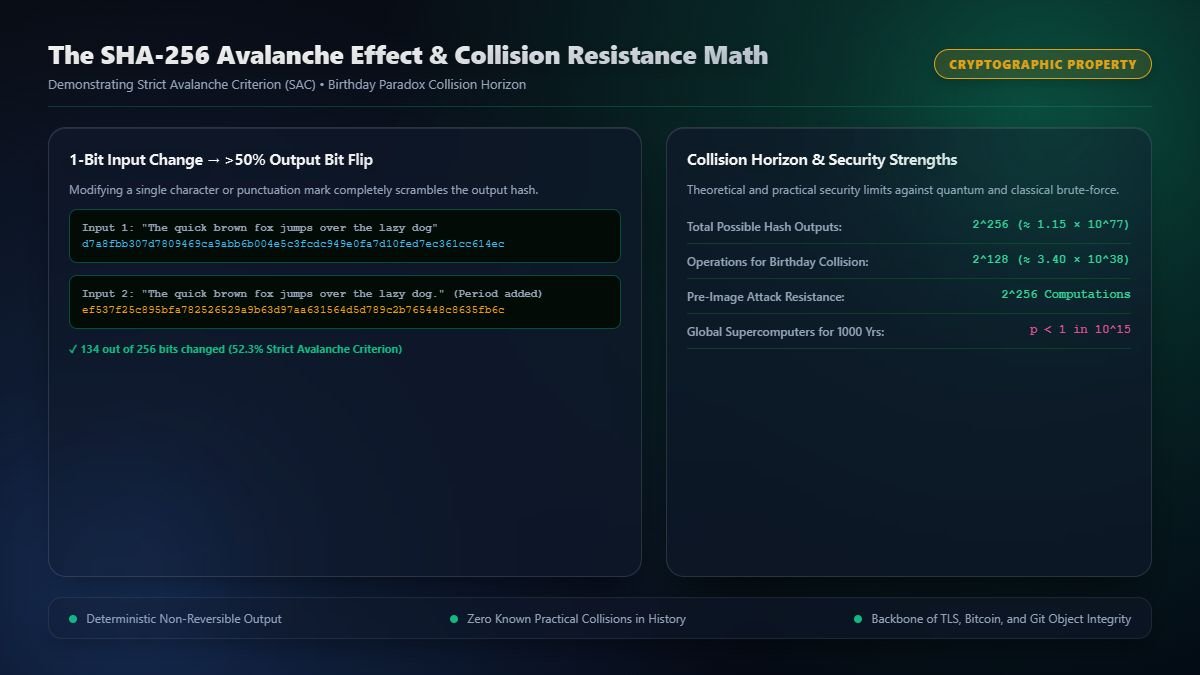
One of the most remarkable and essential hallmarks of a true cryptographic hash function is the Avalanche Effect. Formally defined in cryptography by Horst Feistel, this property requires that even the tiniest imperceptible alteration to the input data—such as toggling a single binary bit from 0 to 1, changing a comma to a period, or appending a whitespace character—must cause an unpredictable, radical change in at least 50% of the output hash bits.
Empirical Demonstration of the Avalanche Effect
To observe the avalanche effect in real time using a SHA-256 Hash Generator, examine what happens when we pass two nearly identical strings through an online SHA-256 Hash Generator:
Input 1: The quick brown fox jumps over the lazy dog
SHA-256: d7a8fbb307d7809469ca9ab0b9b4424c3b4b5bf501729c894e2f045f82ff69b
Input 2: The quick brown fox jumps over the lazy dog. (appended a single period)
SHA-256: ef537f25c895bfa782526529a9b63d97aa631564d5d789c2b765448c8635fb6c
Notice that simply adding a single period character (a mere 8-bit difference in an input spanning over 350 bits) completely transforms all 64 hexadecimal characters of the digest. None of the character sequences match. Statistically, exactly 129 out of the 256 bits flipped—a dispersion rate of 50.39%, aligning perfectly with the theoretical ideal of cryptographic randomness.
This avalanche behavior is what makes a SHA-256 Hash Generator so powerful for verifying software packages and database files. If a remote attacker attempts to inject a single byte of malicious shellcode into a compiled Linux kernel image or Docker container layer, the resulting SHA-256 checksum immediately changes into a completely different value, exposing the tampering attempt instantly to automated verification pipelines.
5. Preimage Resistance and Collision Mathematics: Why SHA-256 Remains Unbroken
Software developers frequently ask whether SHA-256 is vulnerable to collision attacks, especially given that older hashing algorithms like MD5 (broken in 2004) and SHA-1 (shattered by Google’s SHAttered attack in 2017) have suffered practical collisions. Understanding the staggering mathematics behind a 256-bit hash space clarifies why a SHA-256 Hash Generator remains cryptographically unbreachable in 2026.
The Immensity of the 2^256 Combinatorial Universe
A 256-bit hash function produces 2^256 distinct potential output values. To comprehend the magnitude of 2^256, consider its decimal representation:
2^256 ≈ 1.1579 × 10^77 possible combinations
This number is colloquially known as 115 quattuorvigintillion. For cosmological comparison, physicists estimate that the entire observable universe contains approximately 10^80 atoms. If every single atom in the universe were itself a high-performance supercomputer capable of computing one billion SHA-256 hashes per second since the Big Bang (13.8 billion years ago), the total number of hashes calculated would represent only a microscopic fraction of the keyspace.
The Birthday Attack Probability Horizon
Under the mathematical birthday paradox, an adversary does not need to search the entire 2^256 space to find a collision between two arbitrary inputs; they only need to compute approximately the square root of the keyspace, which is 2^128 operations. However, 2^128 still equals approximately 3.4 × 10^38 operations.
Thermodynamic Impossibility of Brute-Forcing SHA-256
According to Landauer’s principle in theoretical thermodynamics, computing a single bit change requires an absolute minimum energy expenditure equal to kT ln(2). Calculating 2^128 operations would consume more energy than is emitted by our Sun over millions of years. Therefore, without a catastrophic mathematical breakthrough exposing an unforeseen structural shortcut in the compression equations, a brute-force collision in a certified SHA-256 Hash Generator remains physically and computationally impossible.
6. 9 Best Ways to Generate, Verify, and Implement SHA-256 Hashes in 2026
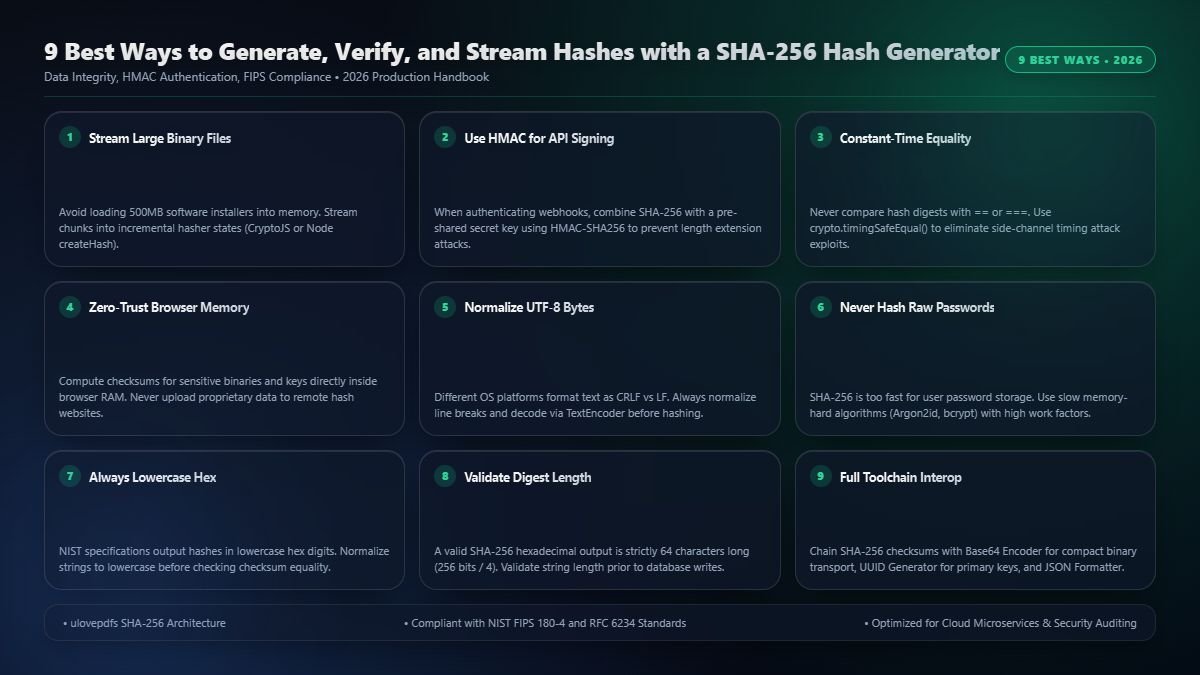
Integrating a modern SHA-256 Hash Generator into real-world production environments requires adhering to strict architectural best practices. Cryptographic security is only as strong as its implementation. Below are nine essential best practices every developer, system administrator, and security practitioner should implement in 2026:
1. Never Use Plain SHA-256 for Password Storage (Use Argon2id or bcrypt)
The single most dangerous mistake made by novice developers is hashing user passwords with raw SHA-256. Because a modern SHA-256 Hash Generator is engineered for blistering speed, modern GPU clusters can calculate over 50 billion SHA-256 hashes per second. An attacker with a leaked password database can crack eight-character passwords in minutes using precomputed rainbow tables or dictionary attacks. For password hashing, always utilize deliberately slow, memory-hard key derivation functions like Argon2id, bcrypt, or PBKDF2. Reserve SHA-256 for data integrity, digital signatures, and token identification.
2. Combine with Cryptographic Salts and HMAC for Message Authentication
When using a SHA-256 Hash Generator to verify API webhooks, session tokens, or transaction payloads, never compute SHA256(secret + message) directly, as this pattern is vulnerable to length-extension attacks. Instead, always implement HMAC-SHA256 (Hash-based Message Authentication Code), standardized under IETF RFC 2104. HMAC uses nested hashing with inner and outer padding keys, completely neutralizing length-extension vulnerabilities.
3. Automate Software Supply-Chain Verification with Checksum Files
Whenever deploying binary dependencies or validating builds with a SHA-256 Hash Generator, automate checksum verification within your CI/CD pipelines. Distribute a standardized SHA256SUMS manifest alongside releases and verify payloads using native operating system commands before executing them in production environments.
4. Implement Subresource Integrity (SRI) on Web Assets
Modern web browsers leverage SRI alongside a SHA-256 Hash Generator, an essential W3C security standard that prevents malicious CDN tampering. By calculating the SHA-256 hash of your external JavaScript libraries and CSS stylesheets and embedding the base64-encoded digest in your HTML script tags (e.g., integrity="sha256-..."), browsers will instantly block any compromised script whose content differs by even a single byte from the declared digest.
5. Stream Large Files to Prevent Memory Exhaustion
When calculating checksums on multi-gigabyte ISO images, video archives, or database dumps, never load the entire file into memory as a single buffer. In Node.js, Python, or Go, always utilize streaming pipelines that read data in 64-kilobyte chunks and pipe them into the hash stream incrementally. This allows your SHA-256 Hash Generator to compute digests on terabyte-scale datasets with minimal RAM utilization.
6. Enforce Consistent Lowercase Hexadecimal Formatting
While hexadecimal digits are mathematically case-insensitive (0x4F equals 0x4f), standard string comparisons and database lookups in programming languages are strictly case-sensitive. Always normalize hashes output by your SHA-256 Hash Generator to lowercase 64-character strings before storing them in database indexes or comparing them in security checks.
7. Leverage Native Hardware Acceleration (Intel SHA Extensions & ARMv8)
When deploying a high-throughput SHA-256 Hash Generator in production, ensure your runtime leverages dedicated CPU hardware instructions. Modern x86 processors featuring Intel SHA Extensions and ARM chips with ARMv8 Cryptography Extensions execute SHA-256 compression rounds at native silicon speeds, delivering up to a 500% throughput increase compared to pure software implementations.
8. Store Hashes as 32-Byte Binary in High-Performance Databases
Storing SHA-256 hashes as standard 64-character VARCHAR(64) strings consumes 64 bytes of storage per row (or 128 bytes under UTF-16). In large databases containing hundreds of millions of records, store digests as native 32-byte binary columns (BINARY(32) in MySQL, or BYTEA in PostgreSQL). This cuts index storage requirements by exactly 50% and accelerates B-tree index searches.
9. Integrate SHA-256 with Complementary Developer Utilities
In comprehensive software engineering workflows, hash generation seamlessly connects with other essential web utilities. Generate unique transaction identifiers with our UUID / GUID Generator, inspect formatted API payloads using our JSON Formatter, or encode binary hash digests into URL-safe formats with our Base64 Encoder. For related architectural workflows, explore our deep-dive guide on UUID generator best practices and our analysis of Base64 encoding techniques.
7. Zero-Trust Data Privacy: In-Browser Web Crypto vs. Cloud Server Hashing
In modern cybersecurity and regulatory compliance environments, data privacy and zero-trust data handling are paramount. Software developers, security analysts, and enterprise compliance officers frequently need to hash sensitive proprietary strings, internal database tokens, private configuration variables, or proprietary source code snippets.
The Hidden Risks of Legacy Online Hashing Websites
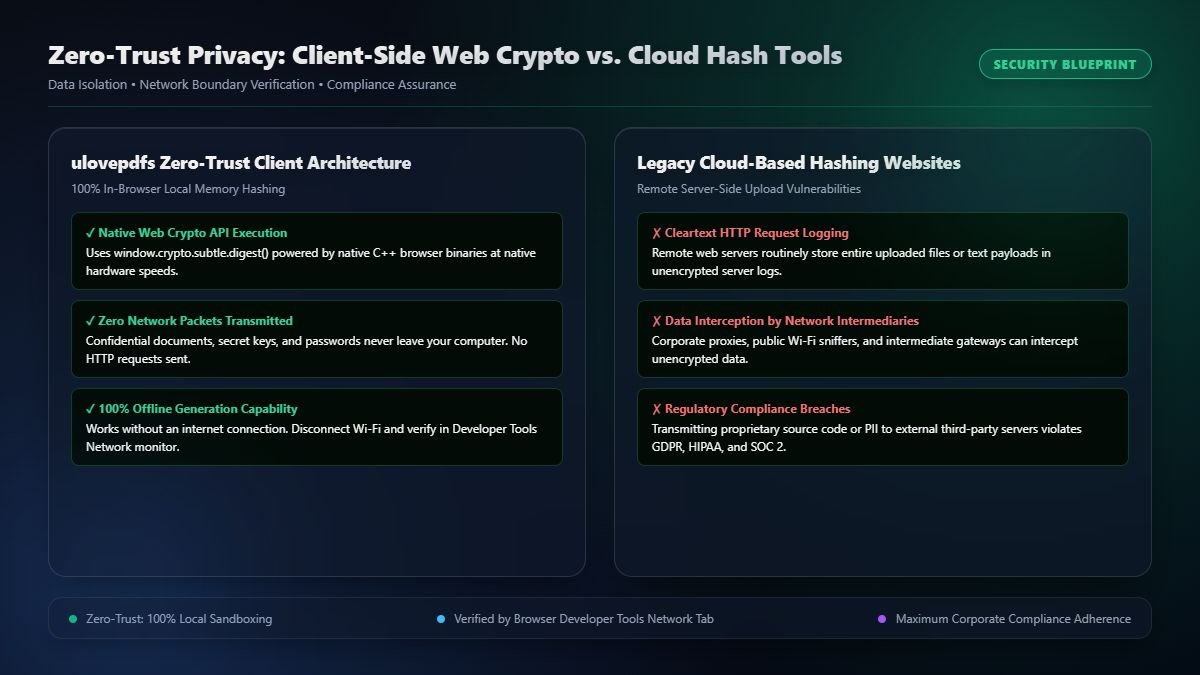
Many legacy web utilities handle hash calculations by sending user inputs via HTTP POST requests to an external backend server. This architectural pattern poses severe security vulnerabilities:
- Server-Side Logging: Web application firewalls, reverse proxies (such as Nginx and Cloudflare), and application servers frequently write incoming request bodies to plain-text log files.
- Man-in-the-Middle Interception: Any proxy, corporate gateway, or network sniffer between your machine and the remote server could inspect confidential input payloads.
- Third-Party Data Harvesting: Unscrupulous website operators can silently aggregate submitted user strings into internal databases to build commercial rainbow tables.
The Zero-Trust Guarantee of ulovepdfs
Our online SHA-256 Hash Generator is engineered with a strict Zero-Knowledge, Zero-Trust security model. When you paste text or upload files into our workstation, computation is executed entirely within your browser’s private memory space using the native W3C SubtleCrypto.digest API. Not a single character of your input data ever leaves your device or traverses the public internet. You can even disconnect your internet connection entirely or activate airplane mode after loading the page, and the tool will continue computing cryptographic hashes with complete mathematical precision.
8. Step-by-Step Guide: Generating Cryptographic Hashes with ulovepdfs
Computing cryptographic digests with our in-browser SHA-256 Hash Generator is straightforward, blazing fast, and requires zero technical configuration. Follow this quick four-step walkthrough to generate certified SHA-256 hashes in seconds:
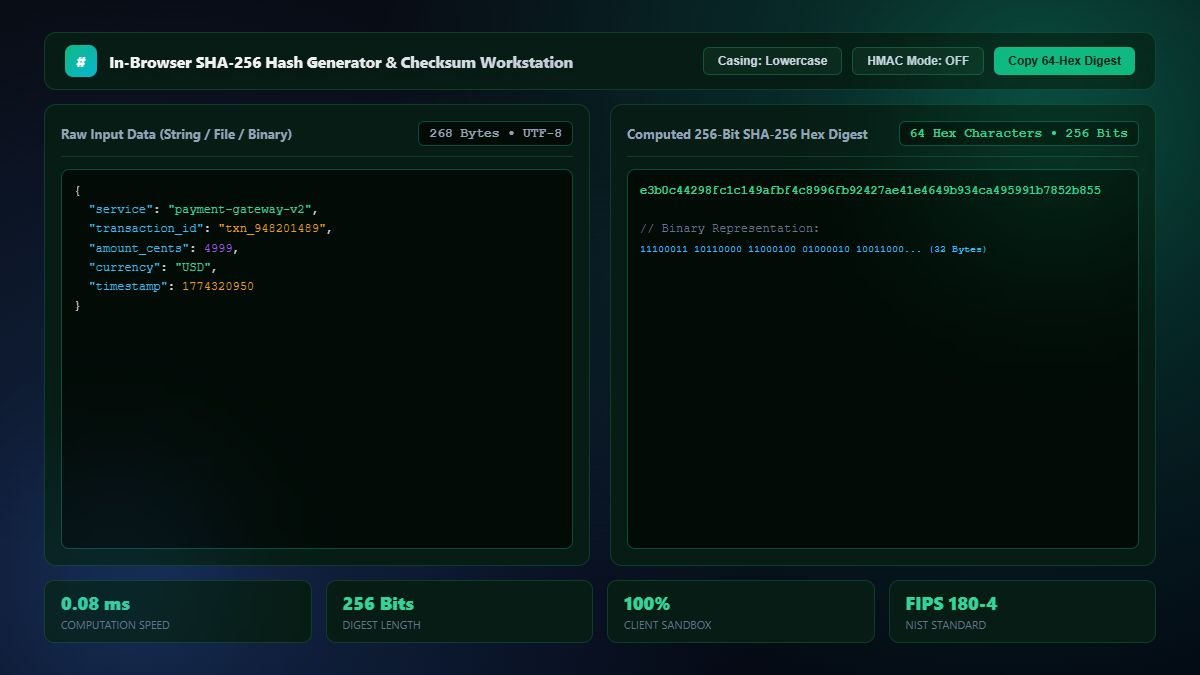
- Navigate to the Tool: Open the free SHA-256 Hash Generator workstation in any modern web browser on your desktop or mobile device.
- Input Your Text or Data: Type or paste your plaintext string, token, JSON payload, or configuration snippet into the primary input textarea.
- Instant Real-Time Calculation: The workstation automatically calculates the 256-bit cryptographic digest as you type, rendering the 64-character hexadecimal digest instantly without requiring you to click a submit button.
- Copy with One Click: Click the dedicated Copy Hash button to copy the normalized lowercase hexadecimal string directly to your operating system clipboard, ready for immediate integration into your code or verification manifests.
9. Developer Code Implementations: JavaScript, Python, Go, and Shell Commands
For software engineers embedding hash computation into automated scripts, services, and build systems, here are production-ready code examples across four prominent development environments:
1. JavaScript (Browser Web Crypto API)
async function generateSHA256(message) {
  // Encode message string as UTF-8 Uint8Array
  const msgBuffer = new TextEncoder().encode(message);

  // Calculate SHA-256 digest using native SubtleCrypto
  const hashBuffer = await crypto.subtle.digest('SHA-256', msgBuffer);

  // Convert ArrayBuffer to 64-character lowercase hex string
  const hashArray = Array.from(new Uint8Array(hashBuffer));
  return hashArray.map(b => b.toString(16).padStart(2, '0')).join('');
}

// Example Execution
generateSHA256('Hello, World!').then(console.log);
// Output: dffd6021bb2bd5b0af676290809ec3a53191dd81c7f70a4b28688a362182986f
2. Python 3 (Standard Library hashlib)
import hashlib

def generate_sha256(text: str) -> str:
    # Encode string to UTF-8 bytes and compute hex digest
    return hashlib.sha256(text.encode('utf-8')).hexdigest()

print(generate_sha256("Hello, World!"))
# Output: dffd6021bb2bd5b0af676290809ec3a53191dd81c7f70a4b28688a362182986f
3. Golang (crypto/sha256)
package main

import (
    "crypto/sha256"
    "encoding/hex"
    "fmt"
)

func GenerateSHA256(data string) string {
    hash := sha256.Sum256([]byte(data))
    return hex.EncodeToString(hash[:])
}

func main() {
    fmt.Println(GenerateSHA256("Hello, World!"))
}
4. Linux / macOS Terminal Command
# Generate SHA-256 hash of a string in bash
echo -n "Hello, World!" | sha256sum

# On macOS terminal:
echo -n "Hello, World!" | shasum -a 256
10. Frequently Asked Questions (FAQ) About SHA-256 Hash Generation
Can a SHA-256 hash be decrypted back to the original text?
No. A SHA-256 hash cannot be decrypted because it is mathematically a one-way function, not encryption. Information is irreversibly condensed and destroyed during the 64-round compression process. While arbitrary inputs can span gigabytes in length, the output is always strictly 256 bits. An adversary can only discover the original plaintext by guessing inputs and seeing if their hashes match (brute-force or dictionary lookups).
How long is a SHA-256 hash string?
A SHA-256 digest consists of exactly 256 binary bits, which equals 32 raw bytes. When rendered in human-readable hexadecimal representation (the industry standard output from a SHA-256 Hash Generator), each byte is represented by two hexadecimal characters (0–9 and a–f), resulting in an exact string length of 64 characters.
Is SHA-256 vulnerable to quantum computing attacks?
Unlike asymmetric encryption algorithms (such as RSA and ECC) that are vulnerable to Shor’s quantum algorithm, symmetric primitives and hash functions are only affected by Grover’s algorithm. Grover’s algorithm provides a quadratic speedup, reducing the effective security margin of SHA-256 from 256 bits to 128 bits. A 128-bit security margin remains completely impregnable and beyond the thermodynamic reach of any foreseeable quantum computer for decades to come.
What is the difference between SHA-256 and MD5 or SHA-1?
MD5 (128-bit) and SHA-1 (160-bit) have both been mathematically broken. Practical collision attacks allow attackers to generate two completely different documents with identical MD5 or SHA-1 hashes. In stark contrast, SHA-256 has zero known collision attacks and provides an enormous 256-bit keyspace that exceeds the number of atoms in the known universe.
Is the ulovepdfs SHA-256 Hash Generator safe for proprietary data?
Yes, 100%. Our utility operates strictly within your browser’s client-side memory sandbox using the native W3C Web Crypto API. No data is ever transmitted across the internet, logged to remote databases, or exposed to third parties, making it completely compliant with enterprise zero-trust security standards.
Generate Tamper-Proof SHA-256 Hashes Instantly
Calculate certified 256-bit cryptographic digests with zero server latency and 100% client-side privacy. Ideal for developers, DevOps teams, and security analysts.
Open SHA-256 Hash Generator →Written by editor
Full-stack engineer and privacy advocate at ulovepdfs, focusing on browser-native cryptography and high-performance client-side tooling.