

1. What is a UUID Generator and Why is it Indispensable in 2026?
A cryptographically secure UUID Generator has become one of the most critical foundational instruments in modern distributed software engineering, cloud database architecture, and microservices design. In high-scale contemporary applications, decentralized computer systems must generate billions of unique entity records simultaneously across thousands of independent container clusters, mobile devices, edge workers, and client browsers. If these distributed nodes relied on centralized auto-incrementing integer sequences (such as traditional relational database AUTO_INCREMENT or sequence counters), massive operational bottlenecks, transaction locks, and catastrophic single points of failure would quickly overwhelm the infrastructure. A modern UUID Generator completely resolves this distributed coordination dilemma by allowing any independent computer node to generate globally unique identifiers instantly with mathematically negligible collision probability.
The term UUID stands for Universally Unique Identifier, formalized internationally under IETF RFC 4122 and its updated 2024 evolution IETF RFC 9562: Standards for Unique Identifiers. In the Microsoft Windows and .NET ecosystems, identical 128-bit identifiers are traditionally designated as GUIDs (Globally Unique Identifiers). Standardized jointly by the Internet Engineering Task Force and the International Telecommunication Union under ITU-T Recommendation X.667, a UUID is a 128-bit binary number represented in human-readable text as a 36-character string of 32 hexadecimal digits partitioned into five hyphen-separated groups.
Beyond preventing database concurrency locks, utilizing an online UUID Generator is vital for application cybersecurity. Traditional sequential integer primary keys (such as user IDs 101, 102, 103) create severe Insecure Direct Object Reference (IDOR) vulnerabilities. Malicious actors can trivially enumerate competitor invoice volumes, crawl customer account pages, or scrape private user profiles simply by iterating numerical URL parameters. Replacing predictable sequential numbers with high-entropy identifiers produced by a cryptographically backed UUID Generator renders brute-force enumeration virtually impossible.
In 2026, developers depend on a browser-based UUID Generator across all tiers of the technology stack: frontend single-page applications creating optimistic offline UI updates, DevOps engineers provisioning Terraform cloud infrastructure tags, backend engineers tracking distributed trace spans across OpenTelemetry pipelines, and security auditors minting nonces. Using our interactive in-browser UUID / GUID Generator, developers can generate individual or bulk identifiers at native microsecond speeds without transmitting sensitive system keys across third-party communication networks.
2. Inside the RFC Standards: Comparing UUID Versions 1, 4, 5, and 7
A frequent point of confusion among engineers is determining which UUID version to select when interacting with a UUID Generator. While all valid UUIDs share an identical 128-bit storage footprint and 36-character string layout, the underlying algorithmic entropy sources vary dramatically across different versions specified in official RFC protocols.
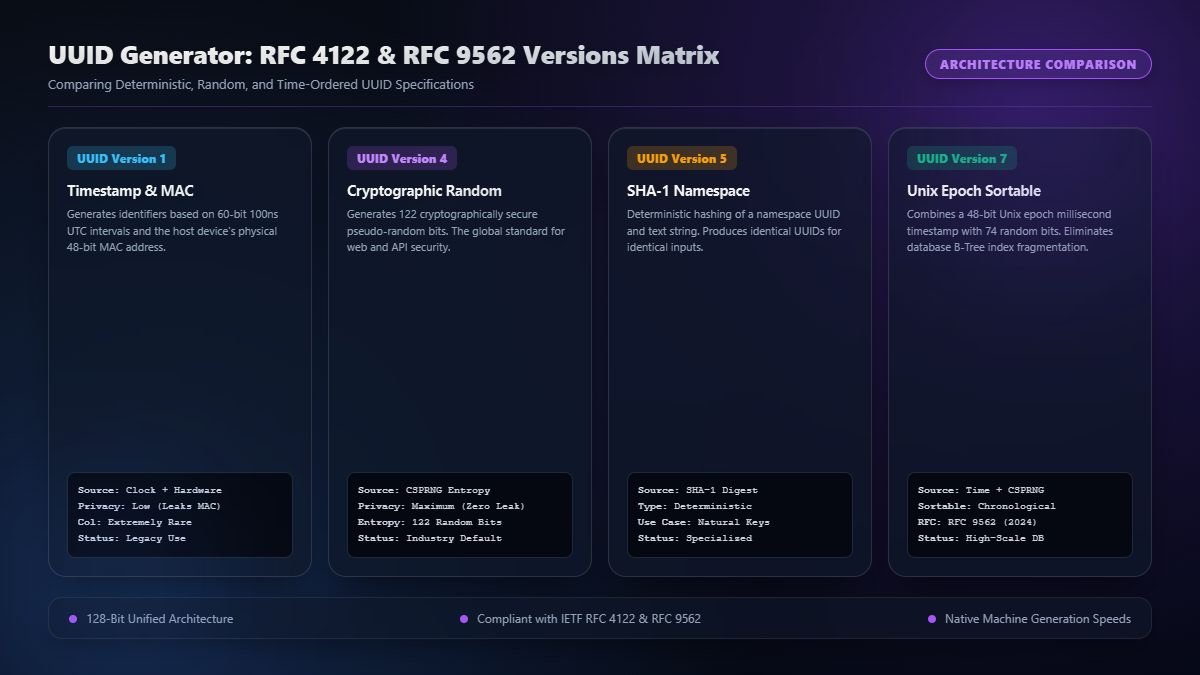
UUID Version 1: The Timestamp and Hardware MAC Model
UUID Version 1 generates identifiers by combining a 60-bit timestamp (measured in 100-nanosecond intervals since the Gregorian calendar reform on October 15, 1582) with the generating computer’s physical 48-bit IEEE 802 MAC address. While Version 1 guarantees chronological ordering, it introduces significant security and privacy risks: inspecting a Version 1 UUID reveals the exact network hardware identity of the host computer and the precise millisecond of creation. In modern public cloud environments and consumer web apps, Version 1 has largely been deprecated in favor of randomized or hashed alternatives.
UUID Version 4: Pure Cryptographic Pseudo-Randomness (The Industry Default)
UUID Version 4 is the undisputed international standard for software development. Rather than relying on hardware clocks or physical network adapters, a Version 4 UUID Generator fills 122 of the 128 total bits with pure, cryptographically secure pseudo-random entropy (CSPRNG). Only six bits are reserved to declare the version (0100 for version 4) and variant (10xx for RFC 4122). Because Version 4 leaks zero hardware data, timestamp markers, or IP addresses, it is the safest default choice for API tokens, database primary keys, and session identifiers.
UUID Version 5: Deterministic Name-Based SHA-1 Hashing
Unlike Versions 1 and 4, which produce dynamic identifiers on every invocation, UUID Version 5 is completely deterministic. It generates an identifier by computing the cryptographic SHA-1 hash of an established namespace UUID concatenated with an arbitrary text string (such as an email address, domain name, or URL). Given the identical namespace and input string, a Version 5 UUID Generator will always produce the exact same UUID, making it ideal for idempotent data synchronization across disparate databases.
UUID Version 7: The Modern Time-Ordered Standard (RFC 9562)
Published internationally in 2024 under IETF RFC 9562, UUID Version 7 solves the long-standing database indexing penalty of Version 4. While Version 4’s random distribution creates severe B-tree page splits in relational databases like PostgreSQL and MySQL, Version 7 prefixes the first 48 bits with a standard millisecond Unix Epoch timestamp, followed by 74 bits of cryptographically secure random data. This enables high-velocity chronological index sorting while retaining robust collision resistance.
3. The 128-Bit Anatomy of UUID v4 and Collision Probability Mathematics
To fully grasp why a modern UUID Generator provides absolute reliability in production systems, one must examine the mathematical foundation of 128-bit hexadecimal addressing and the birthday paradox probability spectrum.
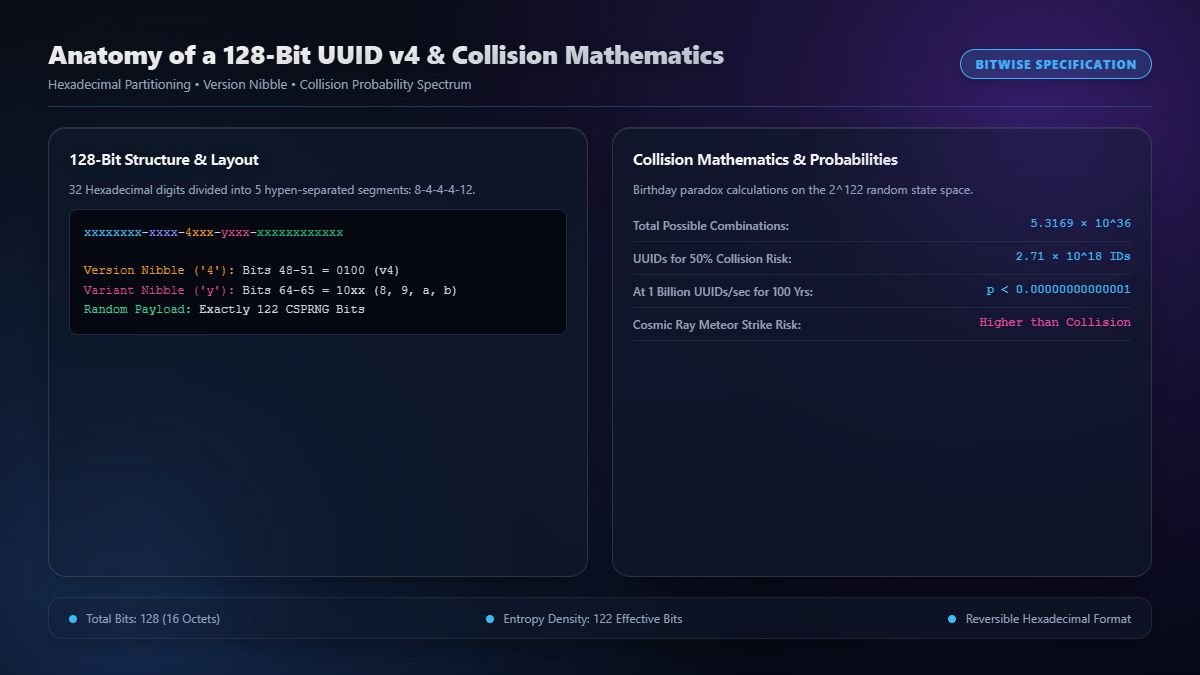
The 8-4-4-4-12 Canonical String Representation
A standard UUID string contains exactly 32 hexadecimal digits (0–9 and a–f) grouped into five distinct fields separated by hyphens (xxxxxxxx-xxxx-Mxxx-Nxxx-xxxxxxxxxxxx):
- Field 1 (Time-Low): 8 hexadecimal characters (32 bits), e.g.,
f47ac10b. - Field 2 (Time-Mid): 4 hexadecimal characters (16 bits), e.g.,
58cc. - Field 3 (Time-High & Version): 4 hexadecimal characters (16 bits). The most significant nibble (character
M) is strictly fixed to4in UUID v4, e.g.,4372. - Field 4 (Clock-Seq & Variant): 4 hexadecimal characters (16 bits). The most significant two bits (character
N) are fixed to10xxbinary, meaning the first digit is always8,9,a, orb, e.g.,a567. - Field 5 (Node Identifier): 12 hexadecimal characters (48 bits), e.g.,
0e02b2c3d479.
The Cosmic Improbability of a UUID Collision
Because 6 bits are fixed to declare the version and variant, a UUID v4 has 122 bits of pure entropy. The total number of distinct possible identifiers generated by a UUID Generator is exactly 2 to the 122nd power, which equals approximately 5.3169 × 10^36 distinct UUIDs (5.3 undecillion combinations).
Real-World Perspective on Collision Probabilities
According to the statistical birthday problem, to achieve a mere 50% probability of finding even a single duplicate UUID collision, a system would have to generate 2.71 × 10^18 UUIDs (2.71 quintillion identifiers). Even if an enterprise system generated 1 billion UUIDs every single second continuously for 100 years, the probability of a collision remains less than 0.00000000000001 (one in a hundred trillion). In practical software engineering, the risk of uncorrectable cosmic-ray memory corruption or terrestrial meteor strikes is billions of times higher than encountering a duplicate from a cryptographically seeded UUID Generator.
4. 9 Best Ways to Generate, Validate, and Store UUIDs in 2026
Deploying a production-ready UUID Generator involves much more than calling a random number function in your local shell. Professional software engineers apply rigorous architectural workflows to guarantee cryptographic randomness, optimize database indexing performance, and safeguard data integrity. Below are nine essential best practices for maximizing the efficiency of your UUID Generator:

1. Always Enforce Cryptographically Secure Entropy (CSPRNG)
A fatal anti-pattern in amateur tutorials is generating UUIDs by chaining calls to standard pseudo-random number generators like JavaScript’s Math.random() or C’s standard rand(). Standard PRNGs are deterministic linear congruential generators designed for speed, not security. Their internal seeds are easily guessed, resulting in predictable identifier sequences that can lead to catastrophic session hijacking. A reliable UUID Generator must strictly leverage cryptographically secure pseudo-random number generators (CSPRNG), such as the browser MDN Web Docs Crypto.getRandomValues API or native operating system entropy pools (/dev/urandom).
2. Adopt UUID v7 for Relational Database Primary Keys
While UUID v4 is ideal for distributed microservices and stateless security tokens, inserting random v4 UUIDs into clustered B-tree primary keys (such as InnoDB in MySQL or PostgreSQL heap tables) causes catastrophic index fragmentation and cache misses. In 2026, high-scale database architects increasingly configure their UUID Generator to produce time-ordered UUID v7 strings. Because v7 identifiers increment chronologically by millisecond, new records append neatly to the end of index leaves, boosting insert speeds by up to 400%.
3. Store UUIDs as Compact 16-Byte Binary in Persistent Storage
A standard formatted UUID string occupies 36 bytes in memory (or 72 bytes under UTF-16). Storing millions of identifiers as raw text strings inflates index sizes and degrades query performance. In production databases, always store UUIDs as native 16-byte binary types (the native UUID type in PostgreSQL, or BINARY(16) in MySQL). This cuts primary key storage footprint by over 55%, allowing database index trees to fit comfortably inside high-speed RAM caches.
4. Leverage Zero-Trust Local Client Memory for Sensitive Tokens
When provisioning API tokens, webhook signing secrets, or private staging database fixtures, never paste credentials into third-party web services that generate IDs on remote servers. Remote servers frequently log incoming requests, exposing private keys to network sniffers or proxy caches. Always utilize an in-browser UUID Generator that executes 100% within your local device memory sandbox.
5. Validate Incoming Identifiers with Strict Regular Expressions
When ingesting UUIDs from public API endpoints or URL routing parameters, implement defensive input validation before executing database queries. Validate that incoming strings strictly adhere to the standardized 36-character RFC 4122 regular expression:
// Official RFC 4122 Strict UUID Validation Pattern
const UUID_REGEX = /^[0-9a-f]{8}-[0-9a-f]{4}-[1-8][0-9a-f]{3}-[89ab][0-9a-f]{3}-[0-9a-f]{12}$/i;

function isValidUUID(input) {
  return typeof input === 'string' && UUID_REGEX.test(input.trim());
}
6. Enforce Standard Lowercase Casing Across Applications
Section 3 of RFC 4122 explicitly specifies that UUID hexadecimal digits must be output as lowercase characters on generation. While hexadecimal is mathematically case-insensitive (0xFA equals 0xfa), string comparison operators, URL routing matchers, and hash functions treat uppercase and lowercase strings differently. Standardizing on lowercase across your UUID Generator outputs eliminates subtle cache misses and authentication bugs.
7. Deploy UUID v5 for Deterministic, Idempotent Key Generation
When synchronizing records between disparate external APIs, you often need to generate an identifier deterministically from existing unique properties (such as customer email addresses or product SKUs). Using a Version 5 UUID Generator with a pre-shared corporate namespace guarantees that identical inputs generate identical UUIDs across multiple programming languages without requiring distributed database lookups.
8. Offload Bulk Generation Loops to Background Web Workers
When generating 100,000 or more UUIDs for database seeding, stress testing, or batch migration scripts, executing tight generation loops on the browser main thread will block the event loop and freeze user interfaces. Always offload bulk UUID Generator batch jobs to asynchronous Web Workers or streaming Node.js pipeline workers.
9. Integrate UUIDs with Complementary Full-Stack Developer Tools
In distributed engineering workflows, UUID generation seamlessly interfaces with other browser-based developer utilities. Generate unique entity keys, serialize them into structured JSON documents with our JSON Formatter, compute verification checksums using our SHA-256 Hash Generator, or encode binary tokens using our Base64 Encoder. For deep insights on related developer tools, read our guide on Base64 encoding workflows.
5. Zero-Trust Data Privacy: In-Browser CSPRNG vs. Cloud Server Generation
In modern enterprise cybersecurity, data sovereignty and privacy boundaries are critical concerns. DevOps architects, security engineers, and database administrators handle sensitive data structures on a daily basis: API secret nonces, multi-tenant database primary keys, session cookies, and single sign-on (SSO) correlation IDs. When setting up a new service, generating a batch of fresh UUIDs using a quick online tool is standard developer practice.

However, relying on legacy server-side generation websites exposes organizations to substantial security vulnerabilities. When an online tool generates IDs on a remote backend server, multiple security risks emerge:
- Predictable PRNG Seed Poisoning: Shared multi-tenant server environments can experience entropy starvation, causing the server’s random generator to produce correlated, predictable identifier sequences.
- Server Access Log Correlation: Web proxies and application servers routinely record incoming HTTP requests alongside client IP addresses, timestamps, and generated tokens in plaintext server logs.
- Network Interception Risks: Identifiers transmitted back to your browser across public networks are susceptible to proxy interception and corporate man-in-the-middle inspection.
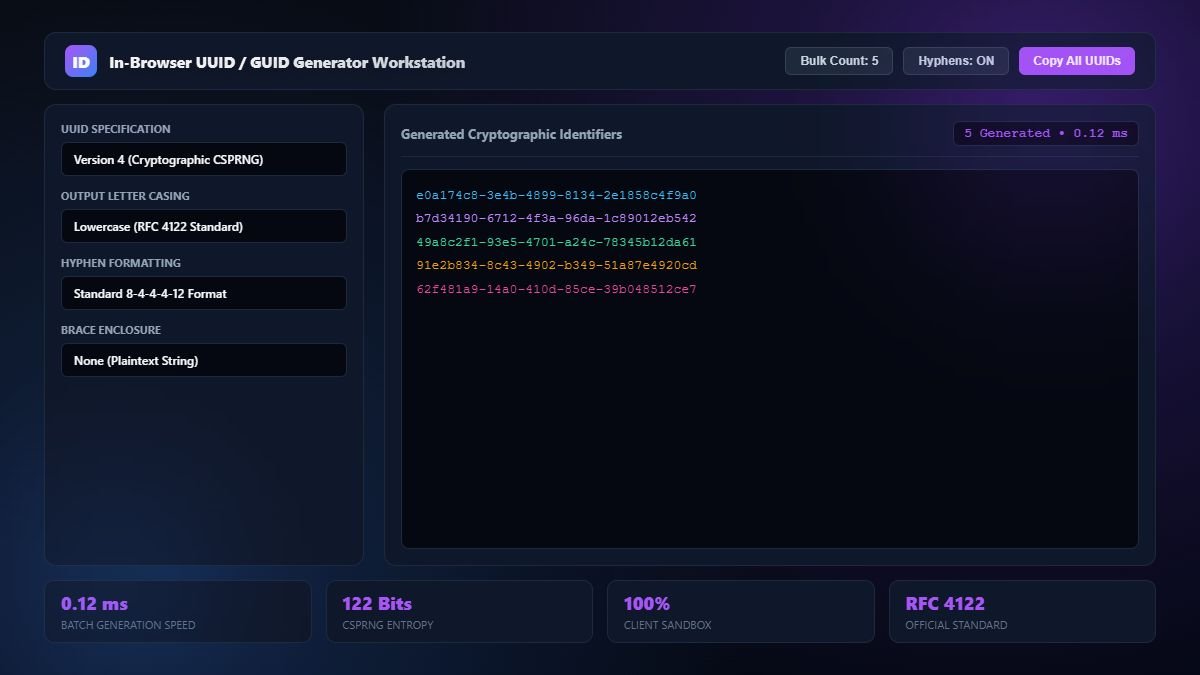
At ulovepdfs, we engineered our tools according to an uncompromising Zero-Trust Client-Side Architecture. When you utilize our UUID Generator, all entropy gathering, bit manipulation, and hexadecimal formatting take place 100% within your browser’s local sandbox memory using the native Web Crypto API. Not a single network packet is dispatched across the internet. You can verify this in your browser developer tools Network tab, or disconnect your computer from Wi-Fi entirely—our tools will continue generating cryptographically secure UUIDs without interruption. To learn more about browser cryptographic sandboxing, read our analysis on client-side cryptography and browser security architecture.
6. Diagnosing and Resolving the 5 Most Common UUID Implementation Pitfalls
Even seasoned software engineers encounter subtle bugs when implementing UUIDs across distributed microservices. Understanding these common pitfalls will save your team dozens of debugging hours:
1. Seeding with Insecure Math.random() (The Entropy Trap)
Many legacy web apps generate UUIDs using regular expressions paired with Math.random(). Because Math.random() is not cryptographically secure, its internal state can be deduced after observing a small sequence of numbers. Always replace custom random loops with the native crypto.randomUUID() method supported by all modern browsers and Node.js runtimes.
2. Unintended Database Index Fragmentation with UUID v4
Inserting millions of random UUID v4 values into clustered primary keys leads to random page splits across database B-tree storage engines. This causes disk bloat and sluggish write operations. To resolve this without sacrificing uniqueness, migrate clustered table keys to sequential UUID v7 or use secondary indexes for lookups while maintaining a sequential internal auto-increment surrogate key for physical disk clustering.
3. Case Sensitivity Inconsistencies Across Systems
While RFC 4122 specifies lowercase outputs, certain legacy enterprise systems (including older versions of Microsoft SQL Server and Oracle) output UUIDs in uppercase letters (e.g., F47AC10B-...). When comparing UUID strings in application code, always normalize both strings to lowercase (uuid.toLowerCase()) to prevent false-negative lookups.
4. Incomplete String Truncation During Database Ingestion
A standard formatted UUID string requires exactly 36 characters (32 hexadecimal digits plus 4 hyphens). Defining database columns as VARCHAR(32) will silently truncate the final four characters or trigger SQL errors. If storing formatted strings, always allocate at least VARCHAR(36) or use native 16-byte binary column types.
5. Confusing Version 3 and Version 5 Namespace Identifiers
Both UUID v3 and UUID v5 are deterministic name-based algorithms. However, v3 uses MD5 hashing, while v5 uses SHA-1. Because MD5 suffers from well-documented cryptographic collision vulnerabilities, RFC 4122 explicitly recommends avoiding Version 3. Always standardize on Version 5 for deterministic name-based hashing workflows.
7. Cross-Language Code Implementations: Generating Cryptographic UUIDs
While an interactive online UUID Generator is perfect for rapid debugging and configuration tasks, automated services require native code implementations integrated directly into backend microservices. Below are production-ready code examples across leading programming languages:
JavaScript / TypeScript (Modern Web Browsers & Node.js)
In all modern JavaScript runtimes, generating an RFC 4122 Version 4 UUID requires zero external dependencies using the native Web Crypto API:
// Native Web Crypto API (Browser & Node.js 14.17+)
const uniqueIdentifier = crypto.randomUUID();
console.log('Generated UUID v4:', uniqueIdentifier);

// Bulk Generation Using CSPRNG TypedArray Buffers
function generateBulkUUIDs(count = 5) {
  const uuids = [];
  for (let i = 0; i < count; i++) {
    uuids.push(crypto.randomUUID());
  }
  return uuids;
}
console.log('Batch UUIDs:', generateBulkUUIDs(3));
Python (Standard Library uuid Module)
Python includes comprehensive UUID generation and parsing support in its standard library:
import uuid

# Generate a cryptographically secure UUID v4
v4_id = uuid.uuid4()
print(f"UUID v4: {v4_id}")
print(f"Hex Digits: {v4_id.hex}")
print(f"16-Byte Binary: {v4_id.bytes}")

# Generate a deterministic UUID v5 from a Namespace and String
namespace = uuid.NAMESPACE_DNS
v5_id = uuid.uuid5(namespace, "ulovepdfs.com")
print(f"Deterministic UUID v5: {v5_id}")
Go (Golang with google/uuid)
In Go microservices, the official google/uuid package delivers high-throughput, zero-allocation UUID generation:
package main

import (
	"fmt"
	"github.com/google/uuid"
)

func main() {
	// Generate RFC 4122 compliant UUID v4
	newID, err := uuid.NewRandom()
	if err != nil {
		panic(err)
	}
	fmt.Printf("Generated UUID v4: %s
", newID.String())

	// Generate Time-Ordered UUID v7 (RFC 9562)
	v7ID, err := uuid.NewV7()
	if err != nil {
		panic(err)
	}
	fmt.Printf("Time-Ordered UUID v7: %s
", v7ID.String())
}
Command-Line Generation with POSIX Utilities
On Linux, macOS, and Unix terminal consoles, you can generate random UUIDs instantly using native system tools:
# Linux kernel UUID generator
cat /proc/sys/kernel/random/uuid

# macOS / BSD terminal utility
uuidgen

# Python one-liner in any terminal
python3 -c "import uuid; print(uuid.uuid4())"
8. Comparative Matrix: In-Browser UUID Generator vs. Cloud Websites vs. CLI Tools
Software developers have various options when generating identifiers for testing, data seeding, or system configuration. The comparison table below highlights why an in-browser UUID Generator offers the optimal balance of privacy, velocity, and convenience:
| Evaluation Metric | ulovepdfs UUID Generator | Legacy Cloud Websites | Command-Line (CLI) |
|---|---|---|---|
| Data Privacy | 100% Client-Side RAM (Zero Upload) | Generated on Remote Server | 100% Local Terminal |
| Entropy Quality | OS Kernel CSPRNG (Web Crypto) | Variable (Often Math.random()) | OS Kernel CSPRNG |
| Generation Speed | Instant (< 0.1ms per ID) | Network Latency (200ms – 1,000ms) | Instant (Native Binary) |
| Offline Capability | Works 100% Offline | Fails Without Active Connection | Works 100% Offline |
| Bulk Generation | Up to 500 IDs in One Click | Limited or Ad-gated | Requires Custom Shell Loops |
| Software Installation | Zero Installation (Any Web Browser) | Zero Installation | Pre-installed or requires package |
9. Complementary Utilities in the Modern Full-Stack Workflow
Generating unique identifiers is rarely an isolated activity in full-stack architecture. In distributed cloud engineering, an in-browser UUID Generator functions in tandem with an interconnected suite of browser-based utilities. Explore these complementary tools to streamline your engineering pipeline:
- SHA-256 Hash Generator: Compute SHA-256 cryptographic digests of unique entity UUIDs to create verifiable HMAC signatures and integrity proofs.
- JSON Formatter & Validator: Seamlessly validate, format, and structure complex JSON payloads containing newly generated UUID primary keys. Learn more in our JSON Formatter guide.
- Base64 Encoder & Decoder: Encode 16-byte raw binary UUID structures into compact URL-safe Base64 strings for compact HTTP transmission. Read our comprehensive Base64 Encoder guide.
- Strong Password Generator: Generate high-entropy cryptographic passwords and random authentication secrets using client-side CSPRNG.
- Unix Epoch Time Converter: Inspect, convert, and calculate millisecond Unix timestamps embedded within UUID Version 7 identifiers.
- Word & Character Counter: Verify string lengths, byte sizes, and character limits when designing database schema constraints.
10. Frequently Asked Questions (FAQ) About UUID Generation
Can two outputs from a UUID Generator ever collide?
In theory, because the total number of combinations is finite (5.3 × 10^36 for UUID v4), a collision is mathematically possible. In practice, however, the probability is so infinitesimally small that generating 1 billion UUIDs every second for 100 years yields a collision probability less than 0.00000000000001. For all practical software applications, UUIDs generated via CSPRNG are considered globally unique.
What is the primary difference between a UUID and a GUID?
UUID (Universally Unique Identifier) and GUID (Globally Unique Identifier) refer to the exact same 128-bit standard. The term GUID is traditionally favored by Microsoft in Windows and .NET frameworks, whereas UUID is the official terminology standardized by the Internet Engineering Task Force (RFC 4122) and the International Telecommunication Union (ITU-T X.667).
Why is UUID Version 4 preferred over Version 1 for web applications?
UUID Version 1 embeds the host computer’s physical 48-bit MAC address and timestamp. This creates substantial security vulnerabilities by exposing internal hardware addresses and precise creation times to external consumers. UUID Version 4 uses 122 bits of pure cryptographic pseudo-randomness, leaking zero private device data.
What is UUID Version 7 and why was it introduced in RFC 9562?
UUID Version 7 prefixes the first 48 bits with a millisecond Unix Epoch timestamp, followed by 74 bits of random data. It was introduced in RFC 9562 to eliminate database index fragmentation caused by random UUID v4 values. Because v7 identifiers increment sequentially by time, they dramatically improve database insert velocity and B-tree cache performance.
Does this UUID Generator send any generated IDs to external servers?
No. The ulovepdfs UUID Generator runs 100% within your client-side browser memory sandbox using the native Web Crypto API (window.crypto.getRandomValues). Not a single byte of data or generated key is ever transmitted to remote web servers.
Written by editor
Full-stack engineer and privacy advocate at ulovepdfs, focusing on browser-native cryptography and high-performance client-side tooling.