

1. What is a BMR Calculator and Why Cellular Thermogenesis Governs Weight Control?
A precision BMR Calculator is one of the most vital quantitative health instruments utilized across clinical endocrinology, sports dietetics, bariatric medicine, and evidence-based fitness coaching. Every single day, millions of individuals embark on weight loss, athletic muscle building, or body recomposition protocols without understanding their body’s foundational caloric engine. By attempting to restrict calories blindly without consulting an accurate BMR Calculator, individuals risk triggering chronic hormonal fatigue, thyroid downregulation, muscle catabolism, and severe metabolic adaptation.
In human exercise physiology and biochemistry, Basal Metabolic Rate (BMR) represents the absolute minimum baseline of chemical energy—measured in kilocalories (kcal) or kilojoules (kJ)—expended by the human body to sustain vital biological life at complete physical, digestive, and thermal rest. Even when an individual lies motionless in bed, living cells relentlessly expend energy to maintain transmembrane ion gradients (specifically powering the sodium-potassium ATPase pump), synthesize enzymatic proteins, power cardiac contractions, pump alveolar respiration, and conduct renal filtration. As documented by clinical nutritional guidelines in The American Journal of Clinical Nutrition (AJCN) and metabolic guidelines from the World Health Organization (WHO), basal metabolism accounts for an astonishing 60% to 75% of an individual’s Total Daily Energy Expenditure (TDEE).
In 2026, sedentary desk jobs, screen-mediated lifestyles, and hyper-palatable processed foods make caloric balance challenging to navigate. Relying on generic 2,000-calorie food labels fails because human energy expenditure varies wildly based on height, weight, biological sex, lean mass percentage, and chronological age. Deploying a calibrated online BMR Calculator establishes an exact somatic baseline, transforming vague dietary guesswork into a precise mathematical formula for sustainable wellness.
Through our dedicated in-browser BMR Calculator Tool, health enthusiasts, trainers, and patients can calculate their basal caloric requirements and total daily maintenance expenditure in milliseconds. Seamlessly integrated alongside our health and measurement suite, including the BMI Calculator, the Chronological Age Calculator, the Weight & Mass Converter, and the Percentage Calculator, our metabolic engine computes your biometrics 100% locally within your client browser memory sandbox with complete biometric confidentiality.
2. Evolution of Metabolic Equations: Harris-Benedict vs. Katch-McArdle vs. Mifflin-St Jeor
To appreciate the scientific accuracy of a modern BMR Calculator, one must explore the century-long evolution of metabolic regression modeling. Over the past 100 years, physiologists have formulated multiple mathematical equations to estimate basal expenditure from somatic dimensions.
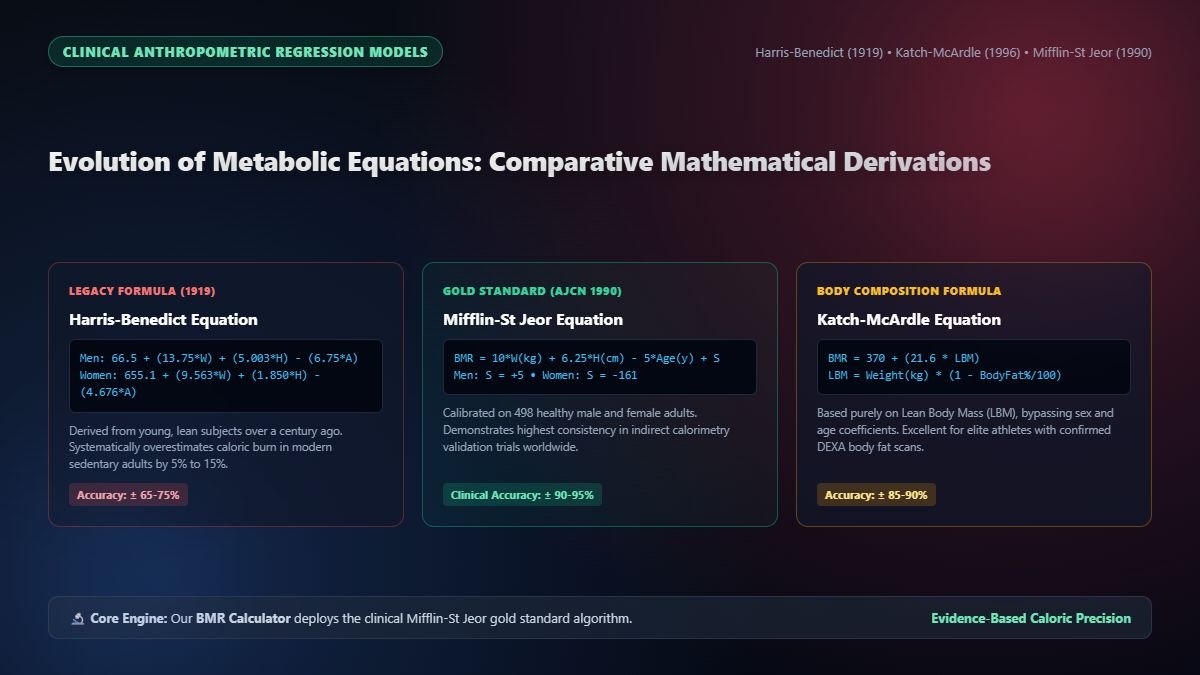
1. The Original Harris-Benedict Equation (1919 & 1984 Roza-Shizgal Revision)
Published in 1919 by James Arthur Harris and Francis Gano Benedict at the Carnegie Institution of Washington, the Harris-Benedict equation represented the world’s first widely adopted metabolic formula. While revolutionary for its era, the study sample consisted primarily of young, lean, physically active college students. In modern populations characterized by higher average body fat percentages and sedentary occupations, the Harris-Benedict formula systematically overestimates resting metabolic burn by 5% to 15%, causing individuals to overeat while assuming they are in a caloric deficit.
2. The Katch-McArdle Equation (1996)
Developed by Frank Katch and Victor McArdle, this equation introduced an innovative paradigm shift: it calculates basal burn strictly from Lean Body Mass (LBM), completely bypassing chronological age, biological sex, and height coefficients:
BMR = 370 + (21.6 * Lean Body Mass in kg)While the Katch-McArdle model is exceptionally accurate for competitive bodybuilders and elite athletes, it requires an accurate measurement of body fat percentage obtained via dual-energy X-ray absorptiometry (DEXA) or hydrostatic weighing. For general populations lacking laboratory body-composition scans, estimating body fat introduces substantial user error.
3. The Mifflin-St Jeor Equation (1990 — Gold Standard)
In 1990, Dr. Mark D. Mifflin and Dr. Sachiko T. St Jeor published their landmark clinical study in The American Journal of Clinical Nutrition. Testing 498 healthy male and female subjects aged 19 to 78 spanning normal weight, overweight, and obese classifications, the Mifflin-St Jeor equation demonstrated the lowest prediction error of any formula in existence. Multiple independent validation trials published by the Academy of Nutrition and Dietetics (AND) confirmed that Mifflin-St Jeor predicts resting energy expenditure within ±10% of laboratory indirect calorimetry in over 90% of non-obese and obese individuals. Consequently, our online BMR Calculator implements the Mifflin-St Jeor algorithm as its computational core.
3. The Mifflin-St Jeor Mathematical Formulation: Male vs. Female Biological Coefficients
Understanding the internal arithmetic of our BMR Calculator empowers users to see exactly how anthropometric measurements translate into daily energy expenditure.
The Mathematical Equations
The Mifflin-St Jeor equation incorporates four primary biological variables: weight in kilograms ($W$), height in centimeters ($H$), chronological age in years ($A$), and a biological sex constant ($S$):
BMR (kcal/day) = 10 * Weight(kg) + 6.25 * Height(cm) - 5 * Age(years) + S

For Biological Males:   S = +5
For Biological Females: S = -161
Physiological Rationale Behind the Coefficients
- Weight Coefficient ($10 imes W$): Represents the primary somatic mass variable. For every additional kilogram of body mass, resting expenditure rises by approximately 10 kcal per day to sustain cellular volume and tissue perfusion.
- Height Coefficient ($6.25 imes H$): Height directly influences total Body Surface Area (BSA). Taller individuals possess a larger surface area relative to body volume, resulting in greater passive thermal dissipation to the environment, requiring additional metabolic heat generation.
- Age Coefficient ($-5 imes A$): Accounts for the natural, biological decline in basal cellular respiration. As humans age, skeletal muscle mass naturally attenuates (sarcopenia) and mitochondrial density diminishes, decreasing basal burn by approximately 5 kcal/day for every year of life past maturity.
- Biological Sex Constant ($+5$ vs. $-161$): Reflects innate endocrine differences in body composition. On average, adult biological males possess a higher proportion of metabolically dense skeletal muscle tissue and lower essential body fat (8-15%) compared to females (20-28%), producing a baseline metabolic divergence of approximately 166 kcal/day.
When you input your data into our BMR Calculator, these mathematical equations execute instantaneously to generate your clinical baseline.
4. From BMR to TDEE: Physical Activity Level (PAL) Multipliers & Daily Energy Balance
While Basal Metabolic Rate represents resting survival energy, human beings do not live in comas. To convert your resting baseline into your Total Daily Energy Expenditure (TDEE), our BMR Calculator integrates calibrated Physical Activity Level (PAL) multipliers.
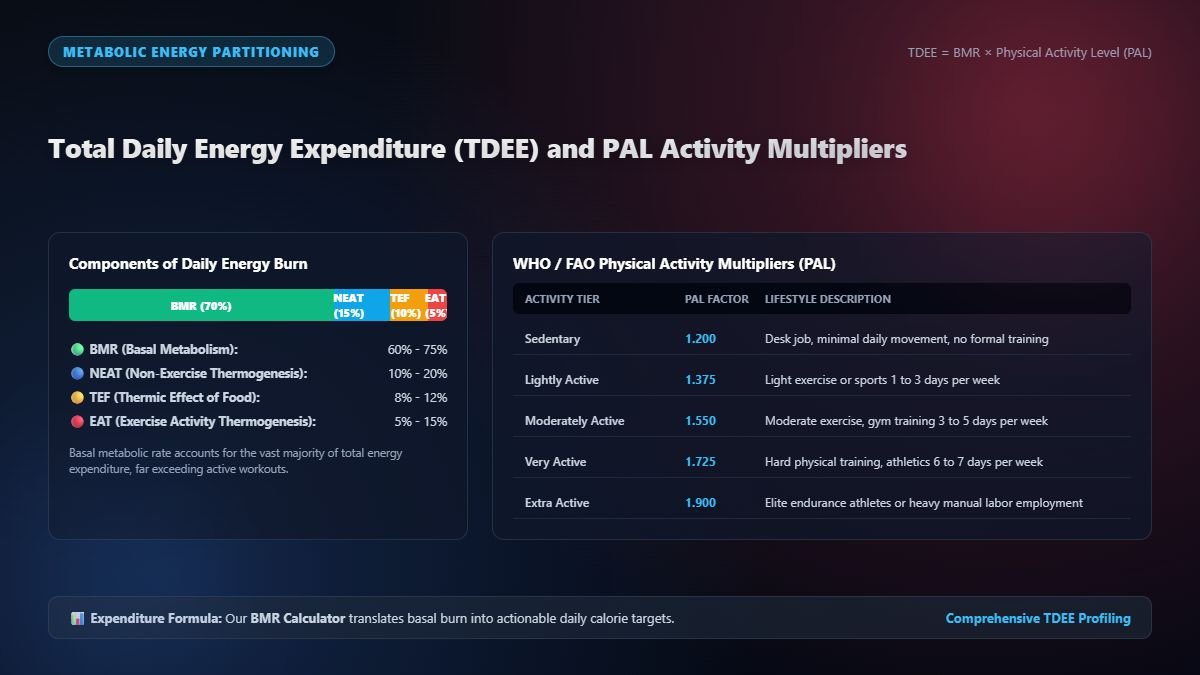
The Four Pillars of Total Daily Energy Expenditure (TDEE)
- Basal Metabolic Rate (BMR — 60% to 75%): Involuntary cellular respiration, heart rate, brain function, and organ filtration.
- Non-Exercise Activity Thermogenesis (NEAT — 10% to 20%): Spontaneous physical movement, including walking to work, typing, fidgeting, maintaining posture, and household chores.
- Thermic Effect of Food (TEF — 8% to 12%): Metabolic energy required to chew, digest, hydrolyze, and assimilate dietary nutrients. Protein requires the highest digestive energy (20-30% of ingested calories), followed by carbohydrates (5-10%) and dietary fats (0-3%).
- Exercise Activity Thermogenesis (EAT — 5% to 15%): Structured athletic training, gym workouts, running, cycling, and resistance exercise.
Standardized WHO / FAO Activity Multipliers
Our online BMR Calculator applies the universally recognized World Health Organization activity tiers:
- Sedentary ($BMR imes 1.200$): Desk employment, little to no structured physical exercise, minimal daily step count (< 4,000 steps).
- Lightly Active ($BMR imes 1.375$): Light physical training or recreational sports 1 to 3 days per week, daily walking (5,000 – 7,500 steps).
- Moderately Active ($BMR imes 1.550$): Moderate exercise, weight lifting, or cardio 3 to 5 days per week, active job lifestyle (8,000 – 10,000 steps).
- Very Active ($BMR imes 1.725$): Intense resistance and cardiovascular training 6 to 7 days per week, manual labor occupations.
- Extra Active ($BMR imes 1.900$): Elite endurance athletes, two-a-day training regimens, or heavy construction employment.
5. Biological Variables Modulating Basal Burn: Lean Muscle, Internal Organs, and Aging
While an anthropometric BMR Calculator provides an extraordinarily accurate statistical baseline, individual metabolic rates can fluctuate slightly based on four distinct physiological determinants.

1. Skeletal Muscle vs. Adipose Tissue Density
Skeletal muscle tissue is highly metabolically active, expending approximately 13 kcal/kg per day at complete rest to maintain intracellular glycogen stores and protein turnover. In contrast, white adipose fat tissue requires only ~4.5 kcal/kg per day. Therefore, two individuals of identical height, weight, and age will exhibit differing metabolic rates if one possesses 12% body fat while the other possesses 32% body fat. Engaging in progressive resistance training to build lean muscle mass permanently elevates your baseline burn in our BMR Calculator.
2. High-Metabolic Organ Expenditure (The Brain and Liver Engine)
A surprising physiological reality is that internal organs account for nearly 60% of total basal energy burn, despite representing less than 6% of body weight. The human brain consumes roughly 20% of your BMR (burning ~300 to 400 kcal/day exclusively via glucose), the liver expends ~21%, the heart accounts for ~9%, and the kidneys consume ~8%. This intense biological baseline demonstrates why drastically under-eating causes cognitive brain fog, cardiac fatigue, and lethargy.
3. Chronological Aging and Sarcopenia
Metabolic rate does not drop precipitously overnight on your 30th birthday. Comprehensive longitudinal isotope studies published in Science indicate that human metabolic efficiency remains remarkably stable between ages 20 and 60. The perceived “metabolic slowdown” in middle age is almost entirely attributable to subtle lifestyle changes: decreased daily step counts (lower NEAT) and progressive, gradual loss of skeletal muscle mass (sarcopenia). By monitoring your numbers with our BMR Calculator and maintaining strength training, age-related metabolic decline can be largely prevented.
4. Endocrine Regulation: Thyroid Hormones and Cortisol
Thyroid hormones—specifically thyroxine (T4) and active triiodothyronine (T3)—act as the master thermostat of human cellular respiration. Circulating T3 stimulates mitochondrial uncoupling proteins and accelerates cellular ATP turnover. Clinical hypothyroidism can depress basal metabolic expenditure by up to 25%, whereas hyperthyroidism can artificially accelerate burn. Similarly, chronically elevated cortisol from unmanaged emotional stress or sleep deprivation impairs insulin sensitivity and promotes central visceral adiposity.
6. Caloric Deficits and Surpluses: Safe Energy Partitioning for Sustainable Body Composition
Once your TDEE has been determined using our BMR Calculator, the laws of thermodynamics dictate physical changes in body mass. To alter body composition safely, caloric intake must be manipulated through controlled deficits or surpluses.
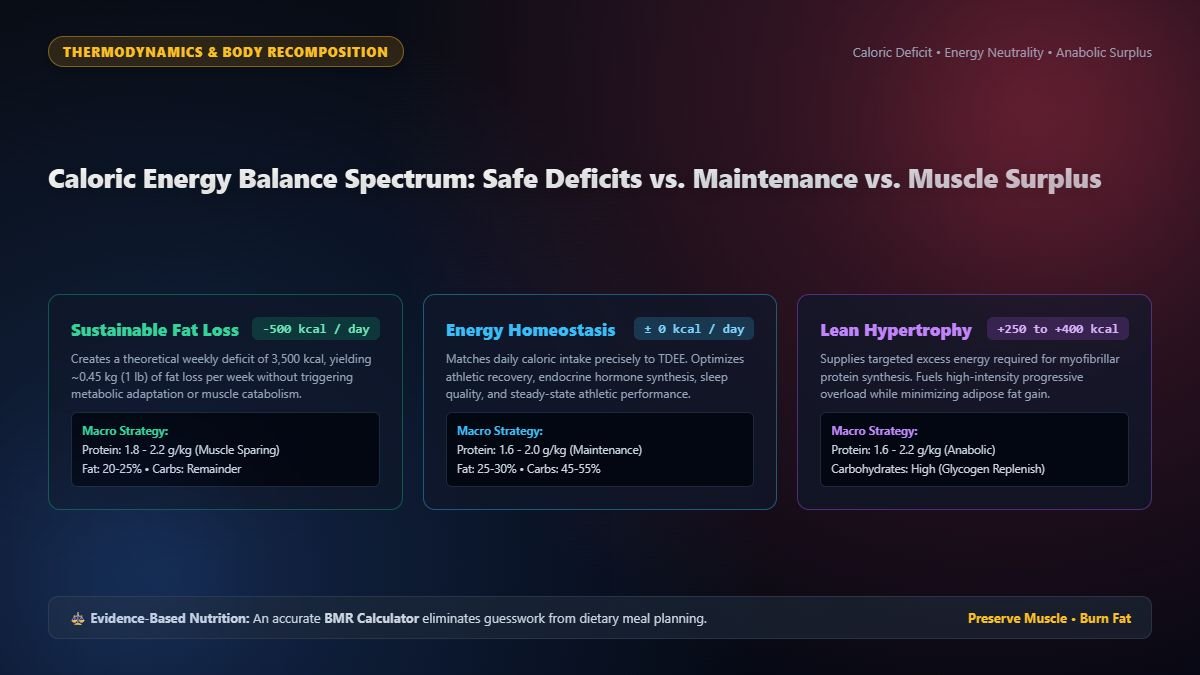
1. Moderate Caloric Deficit for Fat Loss (-300 to -500 kcal/day)
One pound of human adipose fat tissue stores approximately 3,500 kcal of chemical energy. Maintaining a disciplined deficit of 500 kcal per day below your TDEE creates a cumulative weekly deficit of 3,500 kcal, producing an average weight loss of approximately 0.45 kg (1 lb) per week. Crucially, your daily caloric intake should never drop below your BMR baseline for extended periods. Eating below your BMR deprives vital organs of essential energy, triggering intense hunger hormones (ghrelin) and provoking muscle wasting.
2. Caloric Homeostasis for Maintenance (± 0 kcal/day)
Consuming calories equal to your TDEE maintains stable body weight. Maintenance phases are critical for athletes looking to improve endurance, individuals taking structured “diet breaks” to reset leptin levels, and anyone seeking hormonal recovery after prolonged dieting.
3. Controlled Caloric Surplus for Lean Hypertrophy (+250 to +400 kcal/day)
Building new myofibrillar muscle tissue requires an anabolic energy surplus. However, consuming thousands of excess calories leads primarily to rapid fat accumulation. A controlled “lean surplus” of 250 to 400 kcal/day provides sufficient amino acid and glycogen synthesis energy to maximize muscular hypertrophy while keeping adipose gain negligible.
7. Metabolic Adaptation and Adaptive Thermogenesis: Debunking “Starvation Mode”
A widespread fitness myth is the concept of “starvation mode”—the belief that eating too few calories causes the human body to completely halt fat burning and magically store fat from air. Modern exercise physiology refutes this exaggeration while acknowledging the genuine clinical reality of Adaptive Thermogenesis.
When an individual maintains a severe, chronic caloric deficit over several months, the body responds to perceived famine through evolutionary survival mechanisms: spontaneous movement (NEAT) drops subconsciously (you blink less, fidget less, and walk slower), resting heart rate decreases slightly, and active thyroid hormone T3 levels attenuate. This adaptive reduction typically amounts to 100 to 250 kcal/day. Using our BMR Calculator to recalculate your numbers every 4 to 6 weeks as you lose weight allows you to adjust your caloric targets accurately, overcoming weight loss plateaus without resorting to dangerously extreme caloric restriction.
8. Zero-Trust Biometric Privacy: Why In-Browser Health Computing Protects Personal Data
Biometric metrics—including your exact height, weight, age, and lifestyle activity levels—constitute sensitive personal health information. Many commercial health portals transmit user inputs across remote cloud servers, storing biometric data in corporate tracking databases for advertising profiling. Our BMR Calculator is engineered around a Zero-Trust Client-Side Architecture.

100% In-Browser Memory Computing
All calculations inside our online BMR Calculator execute strictly within your local browser memory sandbox via client-side JavaScript. Zero bytes of biometric data, personal health indicators, or session records are ever sent across the web or logged into external databases. You can disconnect your device from the internet entirely, and the calculator will continue computing flawless metabolic outputs with zero lag and total privacy.
9. 9 Best Ways to Calculate and Optimize Basal Metabolic Rate in 2026
Whether your goal is rapid fat loss, lean muscular hypertrophy, marathon training, or general health maintenance, applying evidence-based protocols guarantees optimal progress. Here are the 9 best ways to utilize a BMR Calculator in 2026:
1. Deploy the Mifflin-St Jeor Formula for Evidence-Based Precision
Always verify that your metabolic software uses the Mifflin-St Jeor formula. Our in-browser BMR Calculator implements this clinical standard to ensure you avoid the 10-15% overestimation common to legacy formulas.
2. Never Eat Below Your Basal Metabolic Rate (BMR) Floor
Treat your calculated BMR as an inviolable biological floor. Set your caloric deficit below your TDEE (Total Daily Energy Expenditure), but keep your total intake above your BMR to protect endocrine thyroid function and prevent lean muscle catabolism.
3. Recalculate Your BMR After Every 5 kg of Weight Change
As body mass decreases, the energetic cost of moving your body also declines. Re-enter your new body weight into our BMR Calculator after every 5 kg (10 lbs) of weight loss to adjust your daily caloric targets and prevent frustrating plateaus.
4. Combine BMR with BMI for Comprehensive Somatic Profiling
Pair your metabolic calculation with our companion BMI Calculator to assess clinical weight classifications and evaluate your healthy target weight range.
5. Prioritize Dietary Protein to Maximize the Thermic Effect of Food (TEF)
Consume 1.6 to 2.2 grams of protein per kilogram of body weight daily. Protein requires 20% to 30% of its own caloric value simply to be digested, providing a natural metabolic boost while preserving muscle tissue during dieting.
6. Engage in Progressive Resistance Training to Raise Resting Metabolism
Cardiovascular exercise burns calories during the workout, but resistance training builds skeletal muscle that elevates your resting metabolic burn 24 hours a day, permanently raising your baseline expenditure in our BMR Calculator.
7. Track Daily Step Counts to Prevent Subconscious NEAT Reductions
When dieting, the brain subconsciously reduces fidgeting and spontaneous movement. Maintain a consistent baseline of 8,000 to 10,000 daily steps to prevent your Non-Exercise Activity Thermogenesis (NEAT) from dropping.
8. Accurately Convert Imperial and Metric Weight Measurements
Mifflin-St Jeor calculations require precise metric kilograms and centimeters. If your scale reads in pounds, convert your measurements instantly with our Weight & Mass Converter to guarantee exact inputs.
9. Optimize Sleep Quality to Support Thyroid and Leptin Balance
Chronic sleep deprivation (< 7 hours per night) spikes ghrelin (hunger hormone), elevates catabolic cortisol, and reduces active thyroid hormone T3. Prioritize 7 to 9 hours of quality sleep to maintain peak hormonal metabolic efficiency.
10. Comprehensive Matrix: In-Browser Calculator vs. Indirect Calorimetry vs. Fitness Trackers
Choosing the right metabolic measurement methodology depends upon your clinical requirements, budget, and accessibility. The following comparative matrix outlines key trade-offs across modern platforms:
| Assessment Methodology | Underlying Technology | Clinical Accuracy | Cost & Accessibility | Biometric Privacy |
|---|---|---|---|---|
| ulovepdfs Web Calculator | Mifflin-St Jeor Regression Algorithm | High (± 90-95% of Lab) | 100% Free & Instant Access | 100% Private Client RAM |
| Laboratory Indirect Calorimetry | Metabolic Cart (VO2 / VCO2 Mask) | Gold Standard (99% Exact) | Expensive ($150 – $350 per test) | Hospital Medical Record |
| Wearable Fitness Trackers | Optical Photoplethysmography (PPG) | Poor (± 25-40% Error on Calorie Burn) | Requires Hardware ($150 – $500) | Cloud Database Upload |
| Bioelectrical Impedance (BIA) | Alternating Micro-Current Voltage Drop | Moderate (Hydration Dependent) | Smart Scale Purchase ($40 – $200) | Manufacturer Smartphone App |
11. Step-by-Step Operator Guide: Mastering the ulovepdfs BMR Calculator
Operating our online BMR Calculator is intuitive, fast, and accessible from any smartphone, tablet, or desktop browser. Follow these simple steps to calculate your metabolic targets:
- Select Biological Sex: Choose Male or Female to apply the calibrated Mifflin-St Jeor biological sex constant ($+5$ or $-161$).
- Enter Anthropometric Inputs: Input your current age in years, height in centimeters, and body weight in kilograms. (Use our converters if measuring in inches or pounds).
- Specify Physical Activity Level (PAL): Select your lifestyle activity tier from the dropdown (from Sedentary up to Extra Active) to compute your Total Daily Energy Expenditure.
- Generate & Review Results: Click the large Calculate BMR & TDEE button. Your resting Basal Metabolic Rate and daily maintenance calories appear instantaneously on screen, alongside customized daily calorie targets for sustainable fat loss (-500 kcal) or lean muscle building (+300 kcal).
12. Frequently Asked Questions (FAQ) About BMR, TDEE, and Metabolism
What is the difference between BMR and TDEE?
BMR (Basal Metabolic Rate) is the minimum energy your body requires simply to survive in a resting coma state. TDEE (Total Daily Energy Expenditure) is your actual total daily calorie burn, which adds the calories needed for digestion (TEF), daily movement (NEAT), and workouts (EAT) onto your BMR baseline.
Can I safely eat fewer calories than my calculated BMR?
No. Eating below your BMR is medically discouraged unless supervised in clinical bariatric settings. Consuming fewer calories than your resting organs require causes muscle loss, fatigue, nutrient deficiencies, and thyroid downregulation. Always create your caloric deficit below your TDEE, but keep intake above your BMR floor.
Does building muscle increase my BMR?
Yes. Skeletal muscle is metabolically demanding tissue, burning approximately 13 kcal per kilogram per day at rest, compared to only 4.5 kcal/kg for fat. Increasing lean muscle mass permanently elevates your baseline resting metabolic burn.
Is my biometric health data kept confidential?
100% confidential. Our BMR Calculator operates entirely within your local browser memory sandbox via client-side JavaScript. Zero bytes of health, weight, or personal data are transmitted to remote servers or stored in any database.
Written by editor
Full-stack engineer and privacy advocate at ulovepdfs, focusing on browser-native cryptography and high-performance client-side tooling.