

1. What is an Age Calculator and Why is it Essential in 2026?
A precision Age Calculator is one of the most widely utilized, indispensable, and universally accessed temporal utilities on the global internet. Every single day, millions of individuals, human resources professionals, medical practitioners, legal administrators, school admissions officers, and software engineers turn to an Age Calculator to determine exact chronological duration between a specific historical birth date and the present moment. While counting completed years might seem deceptively straightforward at first glance, computing exact human age down to the precise number of completed months, days, hours, and seconds involves complex temporal mathematics that manual mental arithmetic simply cannot resolve with reliable accuracy.
The concept of age calculation is anchored in international temporal standards formalized by the International Organization for Standardization under ISO 8601 and astronomical timekeeping maintained by the National Institute of Standards and Technology (NIST). Unlike metric physical measurements that divide cleanly into base-10 decimals, the human calendar is an irregular solar-lunar construct featuring months with varying lengths (28, 29, 30, or 31 days) and quadrennial leap year shifts. When an individual needs to verify whether they have reached the exact statutory age of majority, qualify for pension disbursements, or confirm infant developmental milestones, an online Age Calculator eliminates manual counting errors and ensures foolproof legal accuracy.
In 2026, accurate chronological tracking intersects with modern biometric science, longevity medicine, and digital record-keeping. Global health institutions like the World Health Organization (WHO) emphasize that establishing an exact chronological baseline is the vital prerequisite for assessing biological aging trajectories, cognitive longevity, and pediatric growth percentiles. Utilizing an automated in-browser Age Calculator provides instant temporal clarity across diverse cultural frameworks without requiring manual calendar gymnastics.
Through our dedicated in-browser Age Calculator Tool, users can calculate their exact chronological age, determine total days lived, explore upcoming birthday countdowns, and verify milestone anniversaries. Because our workstation runs entirely within your client device’s browser memory, your personal dates of birth and private milestone entries are never transmitted over external networks or logged in remote corporate databases.
2. Calendar Mechanics: The Mathematical Complexity of Gregorian Chronological Math
To appreciate why an automated Age Calculator is necessary, one must understand the intricate mathematical algorithms governing the Gregorian calendar. Introduced in October 1582 by Pope Gregory XIII to correct the Julian calendar’s drift against the solar equinox, the Gregorian calendar requires sophisticated date-difference borrowing logic.
The Variable-Month Borrowing Dilemma
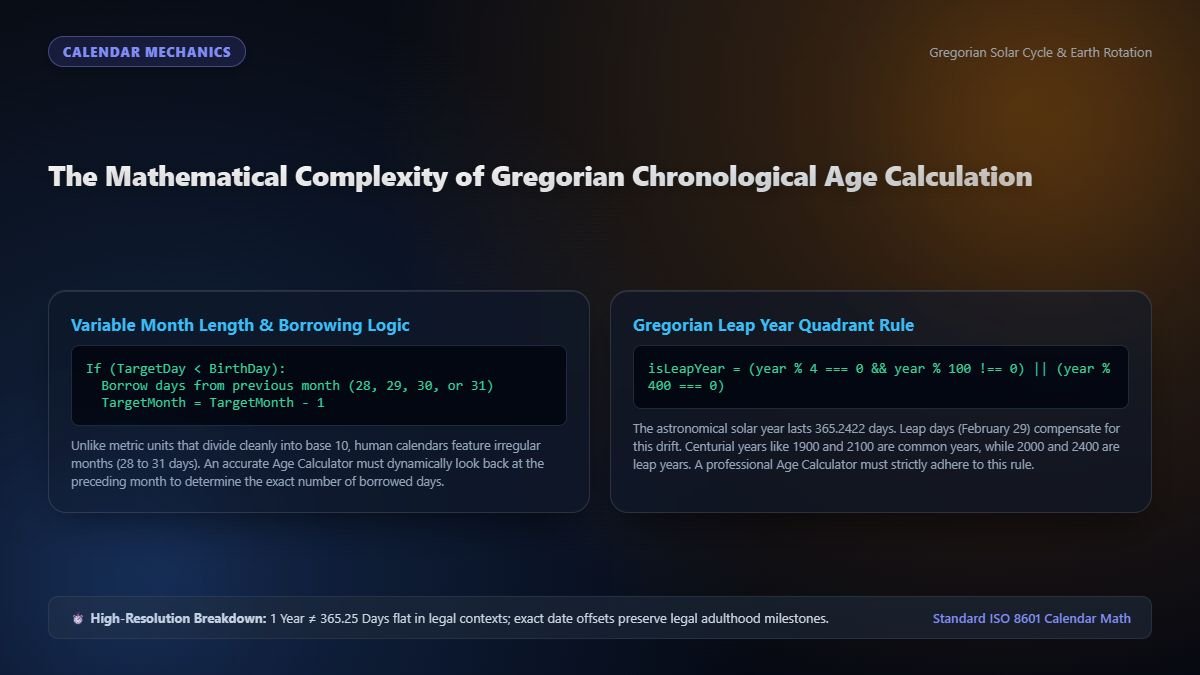
Calculating the difference between two arbitrary calendar dates requires subtracting day, month, and year components sequentially. However, because calendar months do not have a uniform length, subtraction frequently requires borrowing days from the previous month. The borrowing logic executed within our Age Calculator handles these irregular boundaries seamlessly:
- Standard Day Borrowing: If the target current day is smaller than the birth day, the algorithm decrements the target month by one and adds the total number of days belonging to the immediately preceding month.
- Month Transition: If the target month becomes smaller than the birth month, the algorithm decrements the target year by one and adds 12 to the month value.
- Irregular Preceding Month Lengths: Because preceding months may contain 28, 29, 30, or 31 days depending on the calendar cycle, a naive formula that assumes an arbitrary 30-day constant will introduce significant calculation errors.
The 400-Year Gregorian Leap Year Quadrant Rule
Earth requires approximately 365.242189 days to complete a single orbital revolution around the Sun. To prevent the calendar from drifting out of alignment with planetary agricultural seasons, the Gregorian system implements a strict three-tier leap year algorithm:
- Every year evenly divisible by 4 is a leap year (366 days, adding February 29th).
- Except years evenly divisible by 100 are common years (365 days), neutralizing solar overcorrection.
- Unless the centurial year is also evenly divisible by 400, in which case it remains a leap year.
Thus, the year 2000 was a leap year, whereas 1900 was a common year, and 2100 will also be a common year. When computing chronological age across centurial and quadrennial boundaries, our Age Calculator precisely accounts for every leap day, ensuring exact day counts over decades of life.
3. Chronological Age vs. Biological Age: The Cellular Longevity Gap
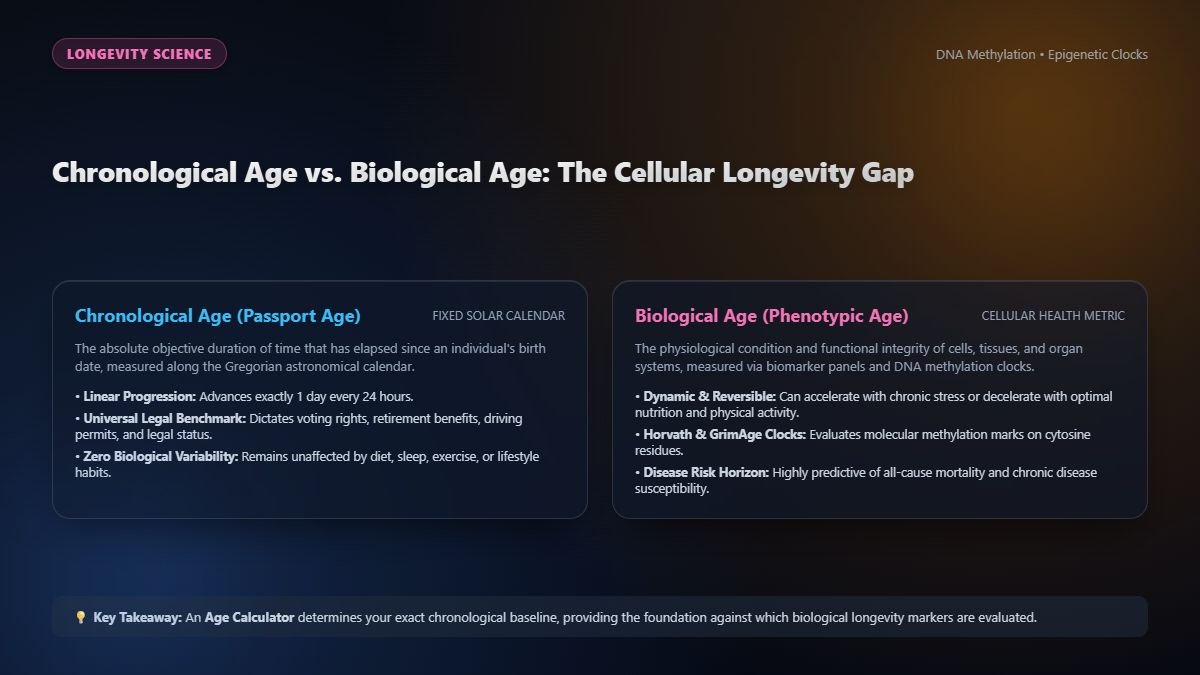
In modern biogerontology and wellness medicine, scientists draw a sharp distinction between the chronological figure produced by an Age Calculator and an individual’s biological phenotypic age. While chronological age reflects solar planetary orbits, biological age reflects internal physiological integrity.
Chronological Age: The Objective Solar Baseline
Chronological age is the exact linear measure of elapsed time since birth. It is non-negotiable, immutable, and uniform across all living organisms. An Age Calculator provides this universal legal benchmark, which serves as the legal foundation for civil milestones, statutory rights, school entry, insurance underwriting, and government retirement programs.
Biological Age: Epigenetic Methylation Clocks
Biological age measures the functional senescence and cellular degradation of your tissues and organs. Pioneered by biogerontologist Steve Horvath, epigenetic clocks measure DNA methylation patterns across specific cytosine-guanine (CpG) dinucleotide sites in the human genome. Highly stressed individuals with poor metabolic health, sedentary habits, and chronic systemic inflammation can exhibit a biological age that is 5 to 10 years older than their chronological score. Conversely, individuals practicing calorie restriction, regular resistance exercise, and restorative sleep can maintain a biological age significantly younger than their output on an Age Calculator.
Phenotypic Biomarkers and Functional Vitality
Beyond DNA methylation, clinical physicians evaluate biological age through functional vitality metrics: cardiorespiratory fitness (VO2 max), grip strength, carotid artery intimal-medial thickness, resting heart rate variability (HRV), and systemic inflammatory markers like hs-CRP. Knowing your exact score on an Age Calculator establishes the baseline against which biological interventions can be evaluated.
4. Global Cultural Perspectives: East Asian vs. Western Age Reckoning
A fascinating anthropological dimension of using an Age Calculator is discovering how different global cultures historically reckoned human age. While the Western full-year system is now the universal international standard, cultural reckoning variations historically created significant cross-border discrepancies.
The Western Full-Year Standard (International System)
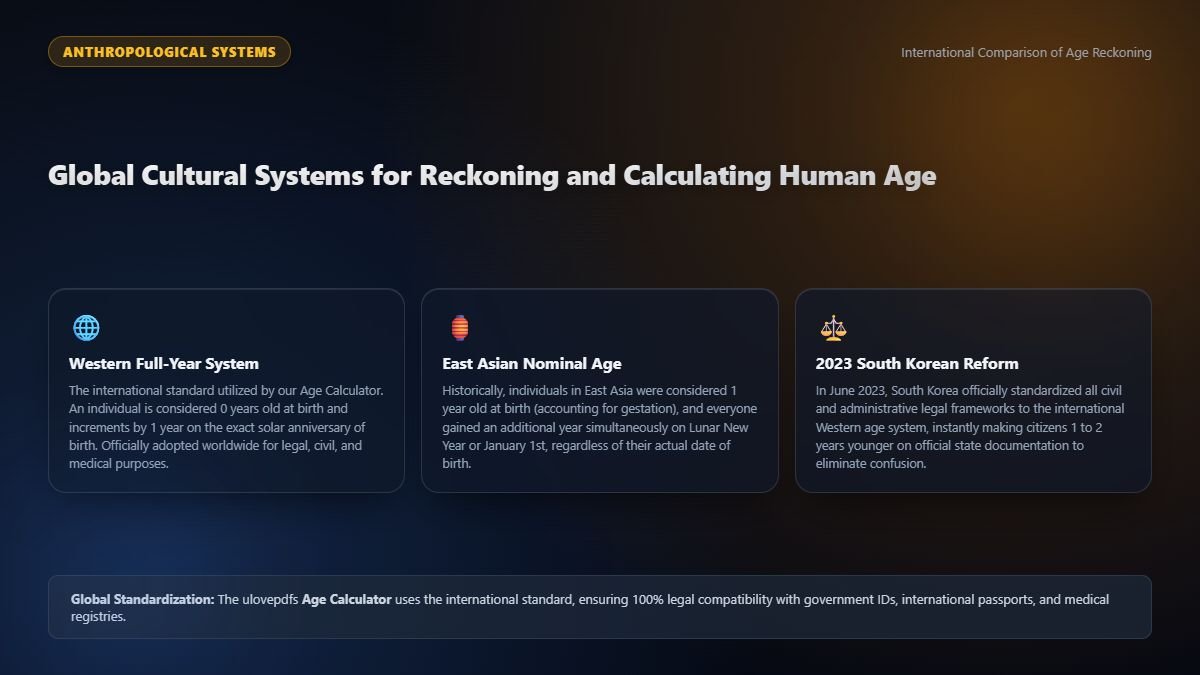
Under the international system utilized by our Age Calculator, a newborn infant is 0 years old on the day of birth. The individual completes their first year of life (turning 1 year old) exactly on the anniversary of their birth 365 or 366 days later. This system is codified internationally for passports, commercial aviation, driver licensing, and clinical medical records.
Traditional East Asian Nominal Age (Korean / Chinese System)
In traditional East Asian age reckoning (historically practiced in Korea, China, Japan, and Vietnam), a child was considered 1 year old immediately at birth, counting the approximate 9 months of intrauterine gestation as the first year of life. Furthermore, age did not advance on individual birthdays; instead, everyone gained an additional year simultaneously on Lunar New Year or January 1st. Consequently, a baby born on December 31st would turn 2 years old on January 1st, despite having lived for less than 48 hours.
The Historic South Korean Legal Reform of 2023
In June 2023, the government of South Korea officially abolished the traditional age reckoning system for all civil, legal, and administrative matters, formally adopting the international Western full-year standard utilized by our Age Calculator. This historic legislative reform instantly made South Korean citizens 1 to 2 years younger on official state documentation, eliminating widespread confusion in insurance contracts, legal proceedings, and pharmaceutical dosing schedules.
5. 9 Best Ways to Calculate, Track, and Verify Chronological Age in 2026
Deploying a modern Age Calculator effectively involves understanding operational best practices across legal, administrative, and technological disciplines. Below are the nine best ways to calculate, verify, and interpret chronological age in 2026:
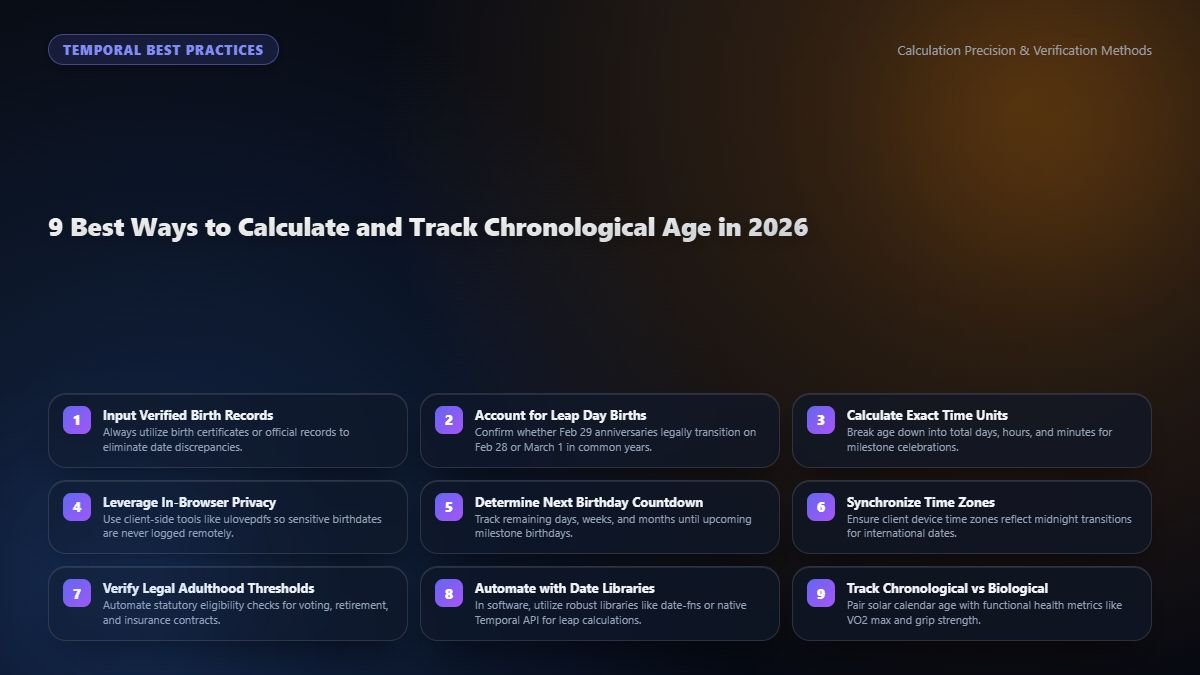
1. Verify Official Primary Birth Documentation
When computing age for formal legal proceedings, immigration visas, or retirement claims, always rely on certified government documentation (such as a birth certificate, consular report of birth abroad, or national passport). Relying on informal recollections can introduce month-day transposition errors, especially between international date conventions (DD/MM/YYYY vs. MM/DD/YYYY).
2. Account for Leap Day Births (February 29th Anniversaries)
Individuals born on February 29th during a leap year face unique legal rules in common years. In jurisdictions following English common law, a leap-day baby legally attains their anniversary on March 1st in common years, whereas other legal codes observe the anniversary at the close of February 28th. A versatile Age Calculator allows users to toggle between statutory conventions to ensure exact compliance.
3. Break Down Age into Granular Time Horizons
While completed years represent the conventional summary, exploring granular time horizons provides meaningful perspective on life milestones. Our Age Calculator calculates total completed months, total elapsed weeks, total elapsed calendar days, and total hours lived, offering fascinating insight for milestone anniversaries, retirement countdowns, and newborn developmental tracking.
4. Prioritize Zero-Data Client-Side Privacy
Dates of birth represent primary Personally Identifiable Information (PII) frequently exploited by identity thieves to compromise financial security and answer banking verification challenges. Never input birthdates into untrusted web tools that transmit data to remote web servers. Utilizing a 100% client-side Age Calculator like ulovepdfs guarantees that your birth records remain strictly within your device’s private browser memory.
5. Determine Upcoming Birthday Countdowns
Planning milestone birthday celebrations, retirement transitions, or statutory legal renewals requires tracking the remaining temporal distance until the next solar anniversary. Configure your Age Calculator to output the exact number of days, weeks, and months remaining until your next birthday milestone.
6. Compensate for International Time Zones and UTC Offsets
When calculating the age of individuals born in different global time zones, astronomical day transitions can vary by up to 24 hours. A child born at 11:30 PM in London is born on a different calendar day than in Tokyo (where it is already 8:30 AM the next morning). In international aviation and immigration contexts, synchronize birth inputs with Coordinated Universal Time (UTC) to eliminate date-boundary discrepancies.
7. Automate Statutory Milestone Audits
Legal privileges are strictly tethered to chronological age milestones: obtaining a driver’s permit (16 years), voter registration (18 years), legal majority and contractual capacity (18 years), alcohol purchase licensing (21 years in the US), and statutory retirement eligibility (62 to 67 years). Human resources departments and compliance auditors utilize an automated Age Calculator to audit employee benefits and compliance dates systematically.
8. Implement Standard Temporal Libraries in Software Systems
Software developers building customer onboarding pipelines or clinical record platforms should never implement ad-hoc date subtraction using arbitrary 365-day constants. In modern JavaScript, utilize the upcoming native Temporal API or modern modular libraries like date-fns and Luxon to compute chronological age with complete leap year and daylight saving awareness.
9. Correlate Chronological Milestones with Biometric Health Markers
Establishing your exact chronological baseline with an Age Calculator allows you to evaluate your biometric health metrics in context. Combine your age with our in-browser BMI Calculator to assess body mass index, or explore our comprehensive guide on Body Mass Index calculations to understand age-adjusted metabolic health.
6. Step-by-Step Guide: Using the ulovepdfs In-Browser Age Calculator
Calculating your precise chronological age with our interactive workstation is blazing fast, user-friendly, and completely private. Follow this simple four-step walkthrough to analyze your temporal profile in seconds:
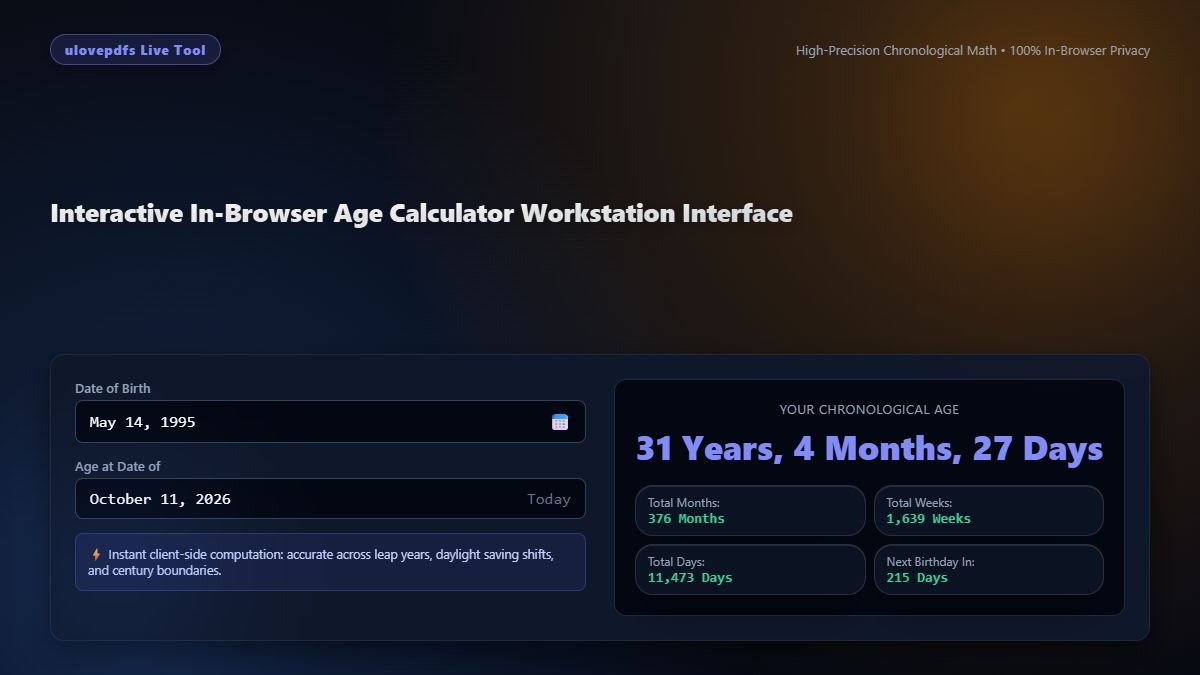
- Select Your Date of Birth: Open the free Age Calculator workstation in any web browser. Use the intuitive date picker to select the exact day, month, and year of birth.
- Specify the Target Date: By default, the workstation automatically selects today’s current date. If you wish to calculate your age on a specific future or past date (such as a retirement date, wedding day, or historical milestone), simply choose a custom target date.
- Instant Real-Time Calculation: The Age Calculator workstation instantly evaluates the calendar difference as you select dates, displaying your age in completed years, months, and days without requiring you to click a submit button.
- Review Granular Milestone Statistics: Explore the comprehensive statistics breakdown panel to view your age expressed as total months lived, total elapsed weeks, total days lived, and an automated countdown timer to your next birthday celebration.
7. Integrating Chronological Calculations with Developer & Productivity Tools
In full-stack engineering, quantitative analytics, and productivity workflows, an Age Calculator connects naturally with other high-performance web utilities on ulovepdfs:
- Calculate Health and Metabolic Metrics: Pair your chronological age with our interactive BMI Calculator to analyze body mass index and healthy weight ranges.
- Calculate Growth Percentages and Life Milestones: Calculate percentage changes in financial investments, retirement contributions, or career milestones using our fast Percentage Calculator. For deep insights on mathematical percentage changes, explore our complete guide on percentage calculation techniques.
- Format JSON Telemetry Records: Serialize exported calendar logs, timestamp manifests, and user demographic data cleanly with our JSON Formatter.
- Analyze Text Journal Entries: Track habit writing volume, personal reflections, and life journals using our in-browser Word Counter.
8. Developer Code Implementations: Calculating Age in JavaScript and Python
For software developers building identity verification systems, onboarding forms, or medical analytics software, here are clean, production-ready code implementations for calculating chronological age accurately:
1. Modern JavaScript (Calendar-Aware Algorithm)
function calculateChronologicalAge(birthDate, targetDate = new Date()) {
  const birth = new Date(birthDate);
  const target = new Date(targetDate);

  let years = target.getFullYear() - birth.getFullYear();
  let months = target.getMonth() - birth.getMonth();
  let days = target.getDate() - birth.getDate();

  // Handle day borrowing from previous month
  if (days < 0) {
    months--;
    // Get total days in the month preceding the target date
    const prevMonthDays = new Date(target.getFullYear(), target.getMonth(), 0).getDate();
    days += prevMonthDays;
  }

  // Handle month borrowing from previous year
  if (months < 0) {
    years--;
    months += 12;
  }

  // Calculate total days elapsed
  const totalDays = Math.floor((target - birth) / (1000 * 60 * 60 * 24));

  return { years, months, days, totalDays };
}

// Example Execution
console.log(calculateChronologicalAge('1995-05-14', '2026-10-11'));
// Output: { years: 31, months: 4, days: 27, totalDays: 11473 }
2. Python 3 (datetime & relativedelta)
from datetime import date
from dateutil.relativedelta import relativedelta

def calculate_exact_age(birth_date: date, target_date: date = None) -> dict:
    if target_date is None:
        target_date = date.today()

    delta = relativedelta(target_date, birth_date)
    total_days = (target_date - birth_date).days

    return {
        "years": delta.years,
        "months": delta.months,
        "days": delta.days,
        "total_days": total_days
    }

print(calculate_exact_age(date(1995, 5, 14), date(2026, 10, 11)))
# Output: {'years': 31, 'months': 4, 'days': 27, 'total_days': 11473}
9. Frequently Asked Questions (FAQ) About Age Calculator Tools
How does an Age Calculator handle leap years?
A precision Age Calculator dynamically accounts for every 366-day leap year occurring between your date of birth and the target date. When borrowing days during month subtraction, the algorithm inspects whether February in that specific year contained 28 or 29 days, ensuring absolute mathematical accuracy down to the exact day.
Can I calculate my age on a future date?
Yes. Our Age Calculator allows you to customize the target calculation date. You can select any future date to discover exactly how old you will be on an upcoming retirement milestone, college graduation day, or golden wedding anniversary.
Why does dividing total days by 365.25 produce a different result?
Dividing total days by 365.25 provides an approximate decimal average, but it fails to respect legal calendar anniversaries. For example, a person attains statutory adulthood on the exact solar anniversary of their birth date, regardless of whether that specific 18-year period contained 4 or 5 leap years. An official Age Calculator uses exact calendar date subtraction to adhere to legal civil definitions.
Does the ulovepdfs Age Calculator log or store my birthdate?
No. Our workstation operates strictly client-side within your browser using local JavaScript. Your birthdate, target calculation dates, and personal identity records are never sent across the internet, logged in cloud servers, or stored in cookies, guaranteeing 100% data privacy.
Calculate Your Exact Chronological Age Instantly
Discover your precise age in years, months, and days, explore total days lived, and countdown to your next milestone birthday with 100% in-browser privacy.
Open Free Age Calculator →Written by editor
Full-stack engineer and privacy advocate at ulovepdfs, focusing on browser-native cryptography and high-performance client-side tooling.