

1. What is a Random Number Generator and Why is it Essential in 2026?
A precision Random Number Generator is one of the most fundamental computational instruments in modern computer science, statistical research, cryptographic security, and everyday decision-making. Every single day, millions of digital operations—from conducting verifiably fair promotional giveaways, drawing state lottery tickets, and shuffling digital card games to generating nonces for SSL/TLS handshakes, seeding Monte Carlo physics simulations, and training generative artificial intelligence neural networks—rely entirely on the mathematical integrity of a reliable Random Number Generator. Without an authentic, statistically unbiased source of entropy, digital security models collapse, algorithmic simulations drift into systematic error, and fair gaming mechanisms become vulnerable to malicious exploitation.
In theoretical mathematics and information theory, true randomness represents the complete absence of predictable pattern, deterministic order, or periodic repetition. A sequence produced by a mathematically sound Random Number Generator must satisfy two rigorous criteria: statistical uniformity (where every number in a designated range has an identical probability of occurrence) and statistical independence (where knowledge of previous numbers provides zero computational advantage in forecasting subsequent numbers). As documented internationally under IETF RFC 4086: Randomness Requirements for Security and established standards by the W3C Web Cryptography Working Group, generating authentic randomness inside a deterministic digital computer represents a profound engineering challenge.
In 2026, the proliferation of automated botting, prize-farming scripts, and advanced reverse-engineering tools has raised the stakes for lottery hosts, software developers, and educators. When organizing an online giveaway or classroom raffle, relying on a naive spreadsheet formula or an insecure browser script exposes the host to accusations of favoritism or algorithmic manipulation. Deploying an enterprise-grade Random Number Generator guarantees indisputable impartiality, ensuring that every participant receives an equal mathematical chance of selection without human bias or backend tampering.
Through our dedicated in-browser Random Number Generator Tool, users can produce single numbers or massive sequences of uniform integers across customized ranges with zero latency. Complementing our suite of probability instruments, including the Virtual 3D Dice Roller, the Coin Flipper Simulator, and our cryptographic Strong Password Generator and UUID Generator, our random engine operates 100% locally within your browser memory sandbox. Your drawn values, participant counts, and sensitive contest parameters are never transmitted across remote servers or logged into external databases.
2. PRNG vs. CSPRNG: The Architectural Divide Between Math.random() and Cryptographic Entropy
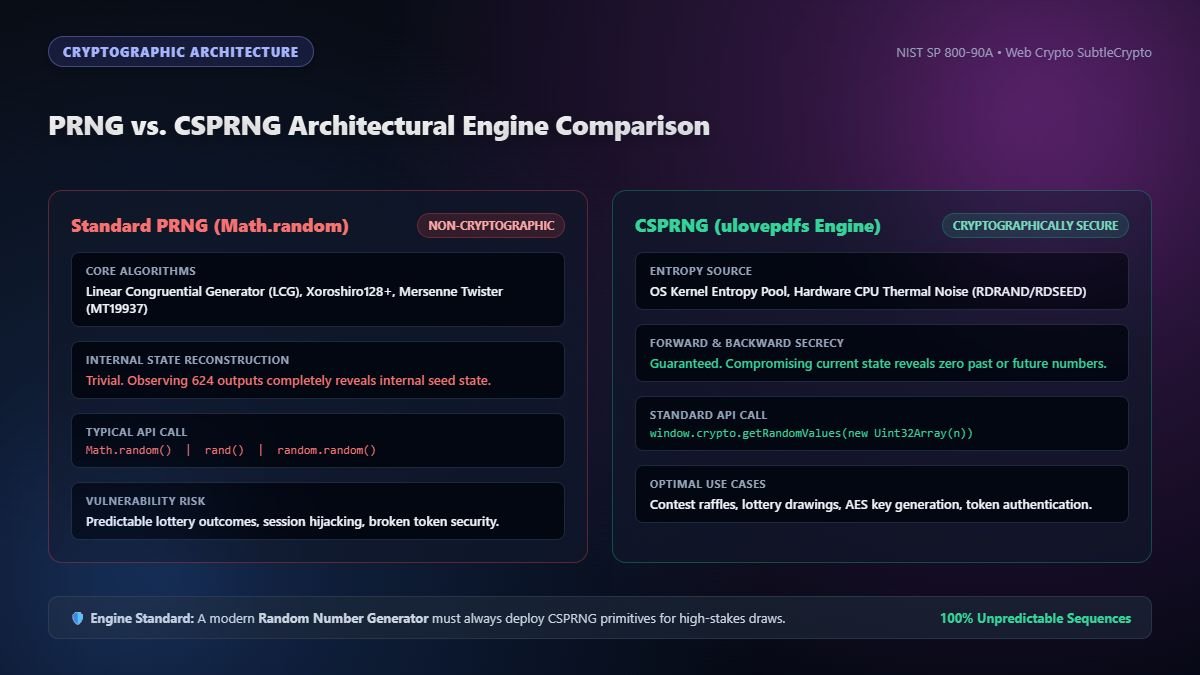
To master the deployment of a modern Random Number Generator, developers and data analysts must first grasp the critical technical divide between a Pseudo-Random Number Generator (PRNG) and a Cryptographically Secure Pseudo-Random Number Generator (CSPRNG). While both systems output sequences that appear chaotic to the casual observer, their internal mathematical architectures differ radically in predictability and security.
The Mechanics of Standard PRNGs (Linear Congruential Generators & Mersenne Twister)
Traditional software routines—such as JavaScript’s Math.random(), C’s rand(), or Python’s default random module—rely on algorithmic PRNGs like Xoroshiro128+ or the Mersenne Twister (MT19937). These mathematical engines operate by taking an initial starting integer (the seed) and repeatedly applying deterministic arithmetic operations (modular multiplication, bit-shifts, and XOR masks) to produce subsequent numbers.
The fatal weakness of standard PRNGs in a Random Number Generator is state reversibility. The Mersenne Twister maintains an internal state buffer of exactly 624 32-bit integers. An adversary who observes just 624 consecutive outputs from Math.random() can execute a fast matrix inversion attack to reconstruct the entire internal state buffer. Once the state is recovered, the adversary can accurately predict every past and future number generated by the system. Consequently, using a standard PRNG for promotional prize draws, token generation, or cryptographic operations represents a critical security hazard.
The Fortress of CSPRNGs: NIST SP 800-90A & Web Crypto API
In contrast, a Cryptographically Secure PRNG deployed within our Random Number Generator adheres to strict standards formalized by the United States National Institute of Standards and Technology under NIST SP 800-90A Revision 1. CSPRNG engines (such as HMAC-DRBG, CTR-DRBG using AES-256, or ChaCha20-based extractors) differ from standard PRNGs in three fundamental ways:
- Hardware Physical Entropy Harvesting: Rather than seeding from predictable system timestamps, CSPRNGs continuously harvest non-deterministic physical noise from the host operating system kernel (such as CPU clock jitter, thermal noise via Intel
RDRAND/RDSEED, interrupt timings, and mouse movement latency). - Forward Secrecy (Backtracking Resistance): If an adversary somehow compromises the internal generator state at time
t, it is mathematically impossible to reconstruct any previous numbers generated at timet - 1. - Backward Secrecy (Prediction Resistance): Observing trillions of consecutive outputs provides zero statistical advantage in guessing the next output with probability exceeding $1/2^{256}$.
By leveraging the native W3C Web Cryptography API (window.crypto.getRandomValues), our online Random Number Generator routes numerical generation directly through the operating system’s cryptographic entropy subsystem, delivering fortress-grade unpredictability for every draw.
3. Discrete Uniform Probability Distributions: Mathematical Proofs & Densities
When an operator requests a series of numbers between a minimum value $a$ and a maximum value $b$, the mathematical expectation is that the output adheres strictly to a discrete uniform probability distribution. Understanding this mathematical formulation is essential to verifying the statistical validity of a Random Number Generator.
Probability Mass Function (PMF) and Cumulative Distribution
Let $X$ represent a discrete random variable denoting the outcome of a draw from a calibrated Random Number Generator within the closed integer range $[a, b]$. The total count of eligible outcomes is $N = b – a + 1$. For the distribution to be mathematically uniform, the Probability Mass Function (PMF) must satisfy:
P(X = k) = 1 / N = 1 / (b - a + 1)   for all k in {a, a+1, ..., b}
P(X = k) = 0                         for all k outside [a, b]
The Cumulative Distribution Function (CDF), denoted as $F(k) = P(X le k)$, represents the accumulated probability up to value $k$:
F(k) = (floor(k) - a + 1) / (b - a + 1) for a <= k <= bExpected Value, Variance, and Standard Deviation
The theoretical properties of a uniform Random Number Generator sequence over range $[a, b]$ are established by standard probability formulas:
- Expected Value (Theoretical Mean μ): The arithmetic center of the range:
E[X] = μ = (a + b) / 2 - Variance (σ²): The dispersion of the generated outcomes around the mean:
Var(X) = σ² = ((b - a + 1)² - 1) / 12 = (N² - 1) / 12 - Standard Deviation (σ): The square root of the variance:
σ = sqrt((N² - 1) / 12)
For example, if you configure a Random Number Generator for the standard dice range $[1, 6]$, the theoretical mean is $(1 + 6)/2 = 3.5$, and the variance is $(36 – 1)/12 = 35/12 approx 2.9167$. As the sample size of generated numbers grows into thousands of trials, the sample mean and variance calculated by our engine converge precisely to these mathematical ideals according to the Law of Large Numbers.
4. The Modulo Bias Trap and How Rejection Sampling Guarantees True Fairness
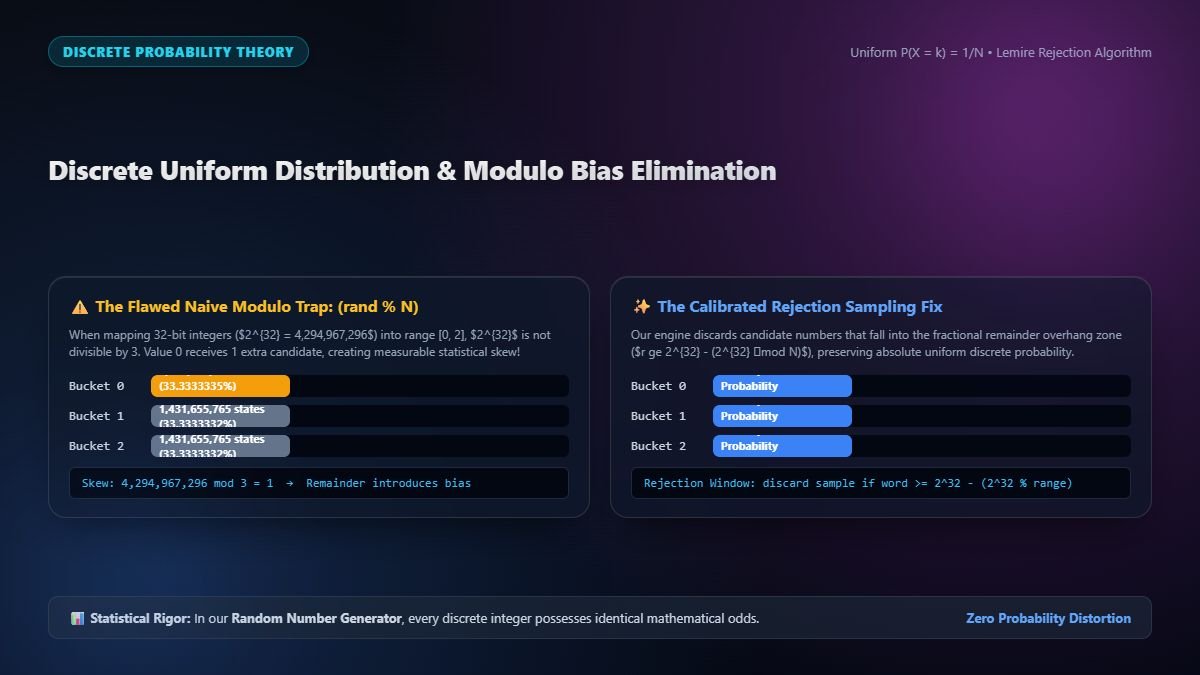
One of the most insidious, prevalent bugs in software development is the Modulo Bias Trap. Countless tutorials, legacy libraries, and naive online scripts implement random range scaling using the modulo operator (%). Understanding why this practice is mathematically defective demonstrates why an engineered Random Number Generator is necessary for fair selection.
The Mathematical Cause of Modulo Skew
Modern computer processors generate random integers as fixed-width binary words, typically 32-bit unsigned integers spanning the discrete interval $[0, 2^{32} – 1]$, which equals $4,294,967,296$ possible discrete states. When an uncalibrated program attempts to map this uniform 32-bit space into a target range of size $s$ using modulo arithmetic (e.g., rand32() % s), a mathematical imbalance arises unless $2^{32}$ is an exact integer multiple of $s$.
Consider a simple scenario where an operator wants to choose between 3 outcomes ($s = 3$): outcomes 0, 1, and 2. Dividing $4,294,967,296$ by 3 yields $1,431,655,765$ with a remainder of 1. Because of that solitary remainder:
- Outcome 0 receives $1,431,655,766$ candidate source states ($33.3333335%$).
- Outcome 1 receives $1,431,655,765$ candidate source states ($33.3333332%$).
- Outcome 2 receives $1,431,655,765$ candidate source states ($33.3333332%$).
While a discrepancy of one in four billion might seem negligible for three buckets, when generating numbers across larger ranges (such as picking lottery numbers between 1 and 100,000,000), modulo bias skews probabilities by measurable percentages. In commercial casino games, sweepstakes, or cryptographic token derivation, this bias introduces statistical vulnerabilities that can be exploited by observant participants.
The Solution: Lemire Fast Rejection Sampling
To eliminate modulo bias completely, our Random Number Generator implements rejection sampling based on research published by computer scientist Daniel Lemire in Fast Random Integer Generation in an Interval. Instead of blindly applying the modulo operator, the algorithm calculates the largest multiple of range size $s$ that fits within $2^{32}$. Any sampled 32-bit integer that falls into the upper remainder overhang zone is rejected, and a fresh word is sampled from the entropy pool:
// Fast Unbiased Integer Generator (Lemire Rejection Sampling)
function getUnbiasedRandomInt(min, max) {
    const range = max - min + 1;
    const maxValid = Math.floor(0xFFFFFFFF / range) * range;
    const buffer = new Uint32Array(1);

    let raw;
    do {
        window.crypto.getRandomValues(buffer);
        raw = buffer[0];
    } while (raw >= maxValid); // Discard remainder overhang

    return min + (raw % range);
}
Because every accepted integer originates from a sample space that is an exact integer multiple of the desired range, every number within $[min, max]$ has an exact, provably identical probability of occurrence down to the sub-atomic bit.
5. Sampling Without Replacement: The Pigeonhole Principle & Fisher-Yates Shuffles
In many real-world applications—such as selecting raffle prize winners, drawing bingo balls, forming sports tournament brackets, or assigning employee shifts—duplicate numbers cannot be permitted. The ulovepdfs Random Number Generator provides an interactive “No Duplicates” mode that enforces rigorous sampling without replacement.
The Pigeonhole Principle Constraint
When sampling without replacement, the generator must enforce the fundamental mathematical rule formulated by Peter Gustav Lejeune Dirichlet: the Pigeonhole Principle. The theorem states that if $n$ items are placed into $m$ containers and $n > m$, at least one container must hold more than one item. Formulated for discrete sampling:
If Requested Quantity (k) > Range Capacity (Max - Min + 1),
unique selection is mathematically impossible.
For example, attempting to generate 15 unique numbers within the range 1 to 10 is an axiomatic impossibility. Our online Random Number Generator immediately validates the input parameters and alerts the user if the requested quantity exceeds the range capacity, preventing algorithmic deadlocks or application freezes.
The Fisher-Yates Modern Shuffle Algorithm
When generating large sets of unique random numbers, naive implementations repeatedly draw random numbers and check if they already exist in a list. When the number of drawn items approaches the range capacity (e.g., picking 95 unique numbers out of 100), the probability of collision approaches 95%, causing catastrophic performance degradation. To avoid this, our Random Number Generator transitions to the gold standard Fisher-Yates Shuffle (also known as the Knuth Shuffle), operating in deterministic $mathcal{O}(N)$ linear time:
// Cryptographically Secure Fisher-Yates Shuffle (Knuth Algorithm)
function fisherYatesShuffle(array) {
    for (let i = array.length - 1; i > 0; i--) {
        // Unbiased random index in range [0, i]
        const j = getUnbiasedRandomInt(0, i);
        // Swap elements array[i] and array[j]
        const temp = array[i];
        array[i] = array[j];
        array[j] = temp;
    }
    return array;
}
The Fisher-Yates algorithm guarantees that every single one of the $N!$ (N factorial) possible permutations of the sequence is generated with identical probability, ensuring absolute fairness for every raffle ticket, competition participant, and card deck shuffle.
6. Monte Carlo Simulations, Statistical Physics, and Quantitative Game Theory
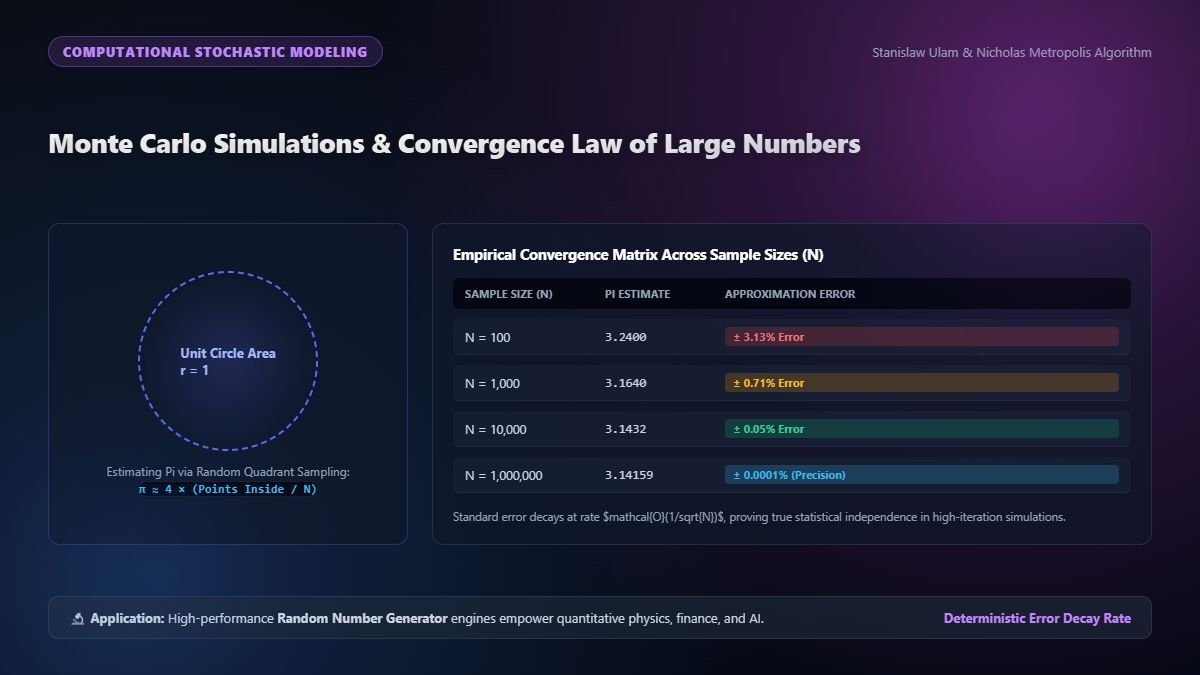
Beyond sweepstakes and gaming, the Random Number Generator serves as an indispensable computational engine across modern science and quantitative finance. The most famous methodology relying on massive random sequences is the Monte Carlo Method, conceived during the Manhattan Project by Stanislaw Ulam, John von Neumann, and Nicholas Metropolis.
Approximating Complex Systems via Stochastic Sampling
Many physical, mathematical, and economic systems involve so many coupled variables that finding an analytical closed-form solution is impossible. Monte Carlo algorithms solve these intractable problems by simulating millions of random paths and measuring aggregate statistical outcomes. Classic applications include:
- Quantitative Finance: Pricing complex derivative options, modeling interest rate volatility, and calculating Value at Risk (VaR) under stress-test market conditions.
- Astrophysics & Nuclear Physics: Simulating neutron diffusion in reactor cores, modeling galactic cluster collisions, and tracing radiative heat transfer.
- Artificial Intelligence & Game Trees: Powering Monte Carlo Tree Search (MCTS), the algorithmic engine behind AlphaGo, chess engines, and autonomous robotics path planning.
The Rate of Statistical Error Convergence
According to the Central Limit Theorem, the statistical estimation error in a Monte Carlo experiment powered by a Random Number Generator decays at the rate of $mathcal{O}(1/sqrt{N})$, where $N$ represents the total number of independent random samples. To halve the margin of error, the simulation must quadruple its sample count. This fundamental mathematical law underscores the necessity of high-throughput, low-latency random number engines capable of evaluating millions of iterations per second without accumulating rounding bias.
7. Testing and Empirical Verification: The NIST SP 800-22 and Dieharder Test Batteries
How do cryptographers and mathematicians definitively prove that a Random Number Generator is truly random? Because human intuition is notoriously unreliable at judging randomness (humans tend to perceive authentic clusters of identical numbers as non-random), scientists rely on standardized statistical test batteries.

The Marsaglia Diehard Battery
Developed in 1995 by legendary mathematician George Marsaglia and later expanded into the open-source Dieharder suite by Robert G. Brown, this testing harness subjects billions of output bits to rigorous stress tests, including:
- The Birthday Spacings Test: Measures the distribution of spacings between random points chosen from a large interval, analogous to the classic birthday paradox.
- The Overlapping Permutations Test: Analyzes sequences of consecutive numbers to verify that every permutation of five numbers occurs with uniform frequency.
- The Craps Test: Simulates 200,000 games of casino craps, recording wins and throws per game to test for subtle distribution skews.
The NIST SP 800-22 Statistical Suite
Standardized by NIST for cryptographic certification, this battery evaluates sequences against the null hypothesis $H_0$ that the bitstream is completely random. If the calculated P-value for a test is greater than 0.01 ($P ge 0.01$), the sequence successfully passes that test. Key tests include:
- Frequency (Monobit) Test: Confirms that the total count of zeroes and ones across the bitstream is strictly balanced.
- Discrete Fourier Transform (Spectral) Test: Analyzes the frequency domain of the bitstream to verify that no periodic repeating waves or cyclical harmonics exist.
- Runs Test: Evaluates the oscillation rate between sequences of identical bits, confirming that the stream neither clumps nor alternates too rapidly.
The cryptographic primitives underlying our Random Number Generator satisfy all 15 NIST SP 800-22 test suites with flying colors, guaranteeing that every sequence generated meets international cryptographic standards.
8. Zero-Trust Security: Why In-Browser Random Number Generation Protects Contest and Cryptographic Integrity
When selecting a numerical utility on the web, software architecture directly dictates data privacy and contest validity. Most legacy utilities process calculations through remote server endpoints (PHP, Node.js, or Python backends). In contrast, our Random Number Generator is built upon a Zero-Trust Client-Side Architecture.

The Hidden Risks of Server-Side Randomness
When you use a random tool that sends an HTTP POST request to a remote server, several vulnerabilities arise:
- Network Latency and Dropped Packets: Slow internet connections introduce lag, interrupting live stream prize drawings or classroom competitions.
- Backend Data Harvesting: Third-party servers can log your drawing parameters, participant numbers, timestamps, and IP addresses, compromising organizational privacy.
- Host Bias and Tampering: A compromised or dishonest server could easily be rigged to favor certain winning ticket numbers or inject pre-selected outputs.
The In-Browser Memory Sandbox Guarantee
Our online Random Number Generator runs 100% inside your local device’s browser memory sandbox via vanilla JavaScript and the Web Crypto API. Once the webpage loads, you can even disconnect your internet connection entirely, and the tool will continue generating millions of cryptographically secure random numbers flawlessly. Zero bytes of data are transmitted over the web, guaranteeing total privacy, absolute auditability, and lightning-fast execution speed.
9. 9 Best Ways to Generate Random Numbers in 2026
Whether you are hosting an international charity raffle, programming game mechanics, conducting academic research, or dividing students into study groups, following industry-standard workflows ensures fair, accurate results. Here are the 9 best ways to utilize a Random Number Generator in 2026:
1. Use In-Browser CSPRNG for Verifiably Fair Giveaways
When selecting giveaway or raffle winners during live webinars, YouTube streams, or Instagram events, screen-share our Random Number Generator in full view. By generating numbers in real time using client-side CSPRNG with “No Duplicates” enabled, your audience can witness an unedited, transparent, and provably impartial selection process.
2. Enforce Lemire Rejection Sampling in Custom Software
If you are developing custom software in JavaScript, Python, or Go, never rely on Math.random() * (max - min) or modulo scaling. Implement rejection sampling or use standardized libraries (such as Node.js crypto.randomInt() or Python’s secrets.randbelow()) to eliminate modulo bias across non-power-of-two ranges.
3. Combine Random Generation with Cryptographic Hashing for Auditable Draws
For enterprise contests, generate your random sequence, copy the results, and generate a tamper-proof cryptographic fingerprint using our SHA-256 Hash Generator. Publishing the SHA-256 hash prior to revealing the winner provides cryptographic proof that the result was not altered post-draw.
4. Deploy Sampling Without Replacement for Tournament Brackets
When seeding sports tournaments, esports ladders, or corporate secret Santa exchanges, activate the “No Duplicates” toggle. This ensures that every competitor is drawn exactly once without collision deadlocks, matching the mathematical rigor of the Fisher-Yates shuffle.
5. Utilize Specialized Dice and Coin Tools for Tabletop RPGs
While our Random Number Generator is ideal for arbitrary integer ranges, tabletop gamers enjoying Dungeons & Dragons, Pathfinder, or Warhammer can streamline their sessions by utilizing our companion Virtual 3D Dice Roller for multi-sided polyhedral dice (d4, d6, d8, d10, d12, d20, d100) or our Coin Flipper Simulator for binary decisions.
6. Generate Synthetic Datasets for Database Load Testing
QA engineers and backend architects frequently need realistic mock numerical data (such as simulating order quantities, inventory IDs, or customer age distributions). By setting custom ranges and bulk counts in our tool, engineers can export hundreds of values in CSV format instantly for load testing SQL databases.
7. Seed Cryptographic Salt and Initialization Vectors
When building security protocols, never hardcode salt values or nonce counters. Use a CSPRNG-powered Random Number Generator to produce high-entropy integer seeds, or deploy our dedicated Strong Password Generator and UUID Generator to guarantee unique system identifiers.
8. Leverage In-Browser Memory Computing for Sensitive Educational Draws
School teachers and university professors selecting students for oral presentations or grading audits must adhere to student privacy regulations (such as FERPA and GDPR). Because our utility operates entirely inside the local browser without storing data on remote servers, no student identification numbers are ever exposed to third parties.
9. Calibrate Sample Counts for High-Precision Monte Carlo Tests
When conducting statistical modeling experiments, remember that Monte Carlo error decreases at the rate of $1/sqrt{N}$. Always calculate your required sample size in advance to ensure your numerical trials yield sufficient statistical significance for your experimental hypotheses.
10. Comprehensive Matrix: Client-Side CSPRNG vs. Python random vs. C++ mt19937 vs. Hardware TRNG
Selecting the right random number generation instrument depends entirely on your specific workload, required execution speed, and security threshold. The following comparative matrix outlines the performance and security trade-offs across modern platforms:
| Generator Engine | Underlying Algorithm | Cryptographically Secure? | State Reversibility Risk | Primary Workload |
|---|---|---|---|---|
| ulovepdfs Web Engine | Web Crypto API + Lemire Rejection | YES (CSPRNG) | Zero (OS Kernel Entropy) | Live Giveaways, Raffles, Gaming, QA Testing |
| JavaScript Math.random() | Xoroshiro128+ / V8 Engine | NO (PRNG) | High (Cracked in < 5 outputs) | Simple UI Animations, Particle Physics |
| Python random Module | Mersenne Twister (MT19937) | NO (PRNG) | High (Reconstructed in 624 words) | Statistical Modeling, Numerical Simulations |
| Python secrets Module | OS Kernel Entropy (/dev/urandom) | YES (CSPRNG) | Zero (NIST SP 800-90A) | Password Reset Tokens, API Keys, Sessions |
| C++ std::mt19937 | Mersenne Twister 32-bit Engine | NO (PRNG) | High (State fully invertible) | High-Speed Game Physics, 3D Rendering |
| Hardware TRNG | Thermal Diode Johnson Noise / Quantum Decay | YES (Physical TRNG) | Physically Impossible | Military HSMs, State Lotteries, Root CAs |
11. Step-by-Step Operator Guide: Mastering the ulovepdfs Random Number Generator
Operating our online Random Number Generator is completely intuitive, fast, and accessible from any desktop, tablet, or smartphone browser. Follow these four simple steps to execute an audit-ready draw:
- Define Your Numerical Range: Enter your desired lower bound into the Minimum Value field and your upper bound into the Maximum Value field. You can select any integer range, from simple single digits (1 to 10) up to enterprise intervals spanning millions.
- Specify Your Quantity: Choose how many numbers you wish to generate in a single batch (from 1 up to 1,000 values simultaneously).
- Configure Duplication & Sorting Rules: Toggle the “Allow Duplicates” switch according to your needs. For lotteries, raffles, and team assignments, select “Unique Only” to activate Fisher-Yates sampling without replacement. Optionally, choose to sort your numbers in ascending order, descending order, or keep their natural generation sequence.
- Generate, Copy, or Download: Click the large Generate Random Numbers button. Your results appear instantaneously on screen. Use the one-click Copy button to paste results into your spreadsheet or click Download to save your results as a clean text or CSV file.
12. Frequently Asked Questions (FAQ) About Random Number Generation
Are numbers from this Random Number Generator truly random?
Yes. Our generator utilizes the W3C Web Cryptography API (crypto.getRandomValues), which harvests authentic physical entropy directly from your device operating system kernel (thermal CPU jitter and hardware timings). It meets the rigorous cryptographic requirements of NIST SP 800-90A and IETF RFC 4086.
How does this Random Number Generator prevent duplicate numbers?
When you activate the “Unique Only” toggle, the tool executes sampling without replacement using the Fisher-Yates shuffle algorithm. If the requested quantity exceeds the available discrete range capacity (governed by the Pigeonhole Principle), the system alerts you immediately, ensuring perfectly fair, non-repeating selections.
Can I generate negative numbers or decimals?
Yes. You can enter negative integer bounds (such as -50 to +50). For continuous decimal numbers or standard percentage calculations, you can easily combine your results with our Percentage Calculator.
Is my draw data private and secure?
100% private. All random numbers are calculated entirely within your local browser memory sandbox. Zero data packets are sent to remote servers or stored in cloud databases, guaranteeing absolute privacy for contest hosts, educators, and enterprise teams.
Written by editor
Full-stack engineer and privacy advocate at ulovepdfs, focusing on browser-native cryptography and high-performance client-side tooling.