

1. What is a Case Converter and Why is it Essential in 2026?
A precision Case Converter is one of the most vital, versatile, and high-frequency productivity instruments utilized across modern software engineering, web development, content management, and digital typography. Every single day, millions of software developers, database architects, copywriters, and technical editors depend on a Case Converter to transform unformatted raw text strings into strict grammatical and programmatic casing formats. Whether an engineer is refactoring API JSON payloads, standardizing database table schemas, normalizing URL routing slugs, or converting accidental caps-lock sentences into pristine typography, a modern Case Converter streamlines text transformations with microsecond efficiency.
In digital typography and computer science, letter case describes the distinction between majuscule (uppercase or capital) and minuscule (lowercase) letterforms. While humans effortlessly parse sentences regardless of casing quirks, computer compilers, database query engines, and search indexing algorithms enforce strict syntactical rules. Standardized internationally under Unicode Standard Annex #44: Unicode Character Database and web standards guided by the W3C Internationalization Working Group, case conversion requires respecting language-specific alphabets, diacritical marks, and multi-byte UTF-8 boundaries. An online Case Converter automates these delicate transformations instantly without manual re-typing.
In 2026, polyglot software architectures demand seamless interoperability between disparate programming languages. A full-stack developer often retrieves database records formatted in Python or SQL snake_case, deserializes them into JavaScript camelCase in the browser frontend, serializes them into Go PascalCase microservices, and binds them to kebab-case CSS classes and REST URL endpoints. Attempting to execute these structural conversions manually invites typographical bugs, broken API routes, and syntax errors. Utilizing an interactive in-browser Case Converter eliminates manual errors and guarantees consistency across enterprise software stacks.
Through our dedicated in-browser Case Converter Tool, developers and writers can transform text across eight distinct casing conventions with a single click. Because our utility executes 100% locally within your client browser memory sandbox, proprietary source code snippets, confidential business copy, and database fixtures are never transmitted over the internet or logged on third-party servers.
2. Typographical Architecture: Inside Programming & Editorial Naming Conventions
To maximize the utility of a Case Converter, software engineers and editorial professionals must understand the specialized role of each casing convention. Modern computer operating systems and compilers treat identifiers differently based on capitalization rules.

1. camelCase (Lower Camel Case)
In camelCase, words are concatenated without whitespace or punctuation. The initial letter of the first word is lowercase, while the first letter of each subsequent word is capitalized (e.g., userProfileData). A Case Converter configured for camelCase produces the undisputed standard for JavaScript, TypeScript, and Java variables, property identifiers, and method names.
2. PascalCase (Upper Camel Case)
PascalCase follows identical concatenation rules to camelCase, except the initial letter of the very first word is also capitalized (e.g., UserProfileData). In modern software development, a Case Converter is frequently utilized to generate PascalCase for React and Vue component definitions, C# and Java class names, TypeScript interfaces, and exported Go struct types.
3. snake_case (Punctuation Underscore Delimited)
In snake_case, all alphabetic characters are lowercased and individual words are separated by underscore characters (e.g., user_profile_data). Standardized by the official Python PEP 8 Style Guide, snake_case is the foundational standard for Python functions, Rust modules, PostgreSQL table columns, and backend JSON dictionary keys.
4. kebab-case (Lisp Case / Hyphen Delimited)
In kebab-case, lowercase words are joined by hyphens (e.g., user-profile-data). Because search engine crawlers treat hyphens as natural word separators while treating underscores as alphanumeric joiners, webmasters and SEO specialists rely on a Case Converter to transform article titles into clean kebab-case URL slugs, CSS class names, and Kubernetes resource identifiers.
5. CONSTANT_CASE (SCREAMING_SNAKE_CASE)
CONSTANT_CASE capitalizes every letter and separates words with underscores (e.g., USER_PROFILE_DATA). In enterprise software engineering, this format designates global configuration variables, immutable environment secrets, and C-style enum constants.
6. Title Case & Sentence Case
For copywriters and digital publishers, a Case Converter provides automated editorial formatting. Title Case capitalizes the primary words of a sentence while keeping minor prepositions, conjunctions, and articles lowercase according to standard journalistic manuals of style (such as AP and Chicago). Sentence case capitalizes only the first letter of the sentence, providing clean readability for modern user interface copy.
3. Cross-Language Syntactic Standards: JavaScript, Python, Go, and Rust
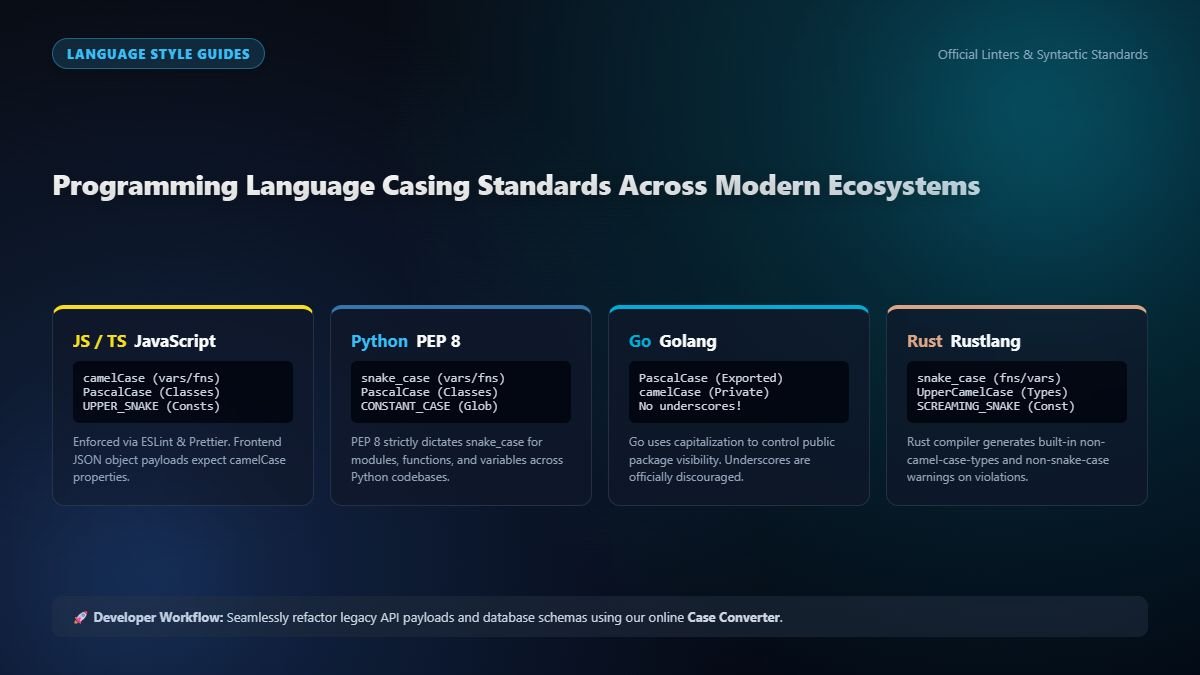
In polyglot cloud environments, adhering to official language style guides is essential for maintainability. Deploying a Case Converter helps developers conform to language-specific linters and compiler requirements.
JavaScript and TypeScript Ecosystem (ECMAScript)
The ECMAScript specification and standard linters (ESLint, Prettier) enforce camelCase for primitive variables and functions, PascalCase for classes and custom React hooks/components, and UPPER_SNAKE_CASE for constant declarations. When ingesting raw data from legacy databases, using a Case Converter normalizes snake_case keys into idiomatic JavaScript camelCase objects effortlessly.
Python (PEP 8 Paradigm)
Python’s PEP 8 style guide explicitly mandates snake_case for functions, methods, and variable names, while reserving CapWords (PascalCase) for class definitions. When converting code from Java or JavaScript into Python, developers run variable lists through an online Case Converter to maintain PEP 8 compliance.
Golang (Export Visibility via Capitalization)
The Go language introduces a unique syntactic rule: capitalization directly governs package visibility. An identifier starting with an uppercase letter (PascalCase) is exported and publicly accessible outside the package, whereas an identifier starting with a lowercase letter (camelCase) is package-private. Underscore delimiters are officially discouraged. A Case Converter allows Go developers to strip underscores and enforce clean camelCase or PascalCase structures.
Rust (Strict Compiler Lints)
The Rust compiler (rustc) contains built-in non-snake-case and non-camel-case warning linters. Rust requires snake_case for functions and modules, UpperCamelCase for structs, traits, and enums, and SCREAMING_SNAKE_CASE for static constants. Violating these conventions triggers compiler warnings during automated cargo builds, making a Case Converter a vital utility in the Rust developer toolbox.
4. Unicode Case Folding: Handling Multi-Byte Characters, Diacritics, and Accents
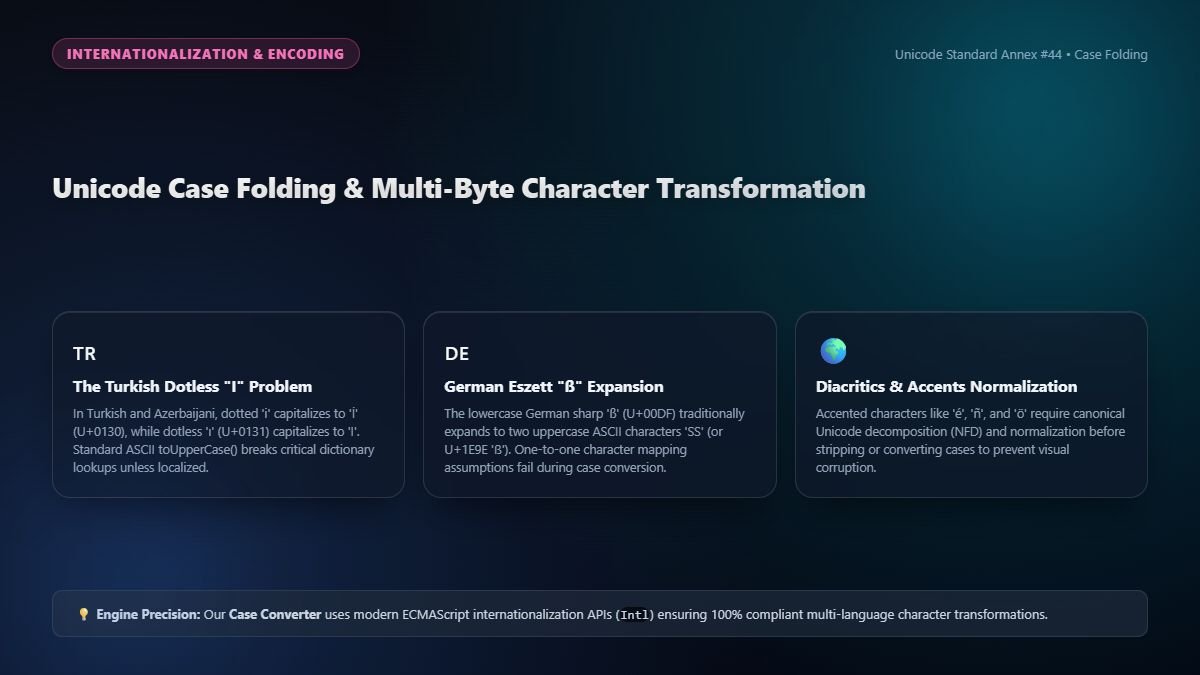
A major pitfall of naive text utilities is assuming that every alphabetic character adheres to simple 7-bit ASCII boundaries. A sophisticated Case Converter implements full Unicode case folding algorithms to preserve linguistic fidelity across international character sets.
The Turkish Dotted and Dotless “I” Anomaly
In Turkish, Azerbaijani, and Crimean Tatar alphabets, the letter “I” exists in two distinct forms: dotted (i / İ) and dotless (ı / I). When an uncalibrated text tool executes standard ASCII uppercase on lowercase i, it produces I, altering the semantic meaning of Turkish vocabulary. A modern Case Converter leverages ECMAScript Internationalization APIs (toLocaleUpperCase) to preserve regional orthography.
The German Eszett “ß” Expansion
In standard German orthography, the lowercase letter ß (Eszett / sharp S, U+00DF) traditionally had no single uppercase glyph and expanded to two uppercase ASCII characters SS. While capital ẞ (U+1E9E) was formally incorporated into the German council for orthography in 2017, case folding algorithms must anticipate string length expansions during transformation. A professional Case Converter accommodates multi-byte character length variations without truncating text.
Diacritics, Accents, and Normalization Forms
Accented characters such as French é, Spanish ñ, and Scandinavian ø can be represented in Unicode either as single precomposed code points (NFC) or as combining character sequences (NFD). When transforming text to uppercase or lowercase, our Case Converter performs Unicode canonical composition to ensure accents remain perfectly attached to their base glyphs.
5. 9 Best Ways to Convert and Standardize Text Case in 2026
Applying text transformations in real-world production environments requires adhering to strict architectural best practices. Below are the nine best ways to convert, standardize, and maintain text case in 2026:

1. Enforce Automated Repository Linters
Prevent casing fragmentation across large engineering teams by embedding automated linters into your continuous integration (CI) pipelines. Configure ESLint for JavaScript/TypeScript, flake8 or Black for Python, and clippy for Rust to flag casing violations before pull requests merge into production branches.
2. Standardize URL Permalinks on Kebab-Case
Search engines treat hyphens as natural word boundaries while treating underscores and camelCase as continuous single tokens. For optimal search engine optimization and user readability, always run blog headlines and product titles through a Case Converter to produce lowercase kebab-case slugs (such as case-converter-guide).
3. Normalize Database Columns to Lowercase snake_case
Relational database management systems (like PostgreSQL, MySQL, and SQLite) handle capitalized identifiers inconsistently. In PostgreSQL, camelCase column names like userProfile require double quotes ("userProfile") in every SQL query, leading to syntax friction. Standardize database schemas to lowercase snake_case using a Case Converter to avoid quoting headaches.
4. Leverage Zero-Data Client-Side Privacy
When transforming proprietary code snippets, unpublished marketing manuscripts, or confidential internal API payloads, never paste text into unverified web utilities that transmit content to remote servers. A client-side Case Converter like ulovepdfs processes all strings locally within your device’s browser memory sandbox.
5. Standardize Editorial Title Case Rules
When publishing articles and blog posts, adhere to standardized editorial style manuals (AP or Chicago). A high-performance Case Converter automatically capitalizes nouns, verbs, and adjectives while keeping minor articles (a, an, the) and prepositions (in, on, with) under four letters lowercase unless they appear at the start of the title.
6. Preserve Technical Acronym Integrity
When transforming technical strings containing acronyms (such as fetchAPIResponse or parseJSONPayload), naive conversion algorithms frequently fragment acronyms into awkward outputs like fetch_a_p_i_response. A well-engineered Case Converter recognizes established computer science acronyms and preserves them as unified semantic tokens.
7. Ensure Multi-Byte Unicode Character Fidelity
When working with international content, always ensure your case conversion tools support multi-byte UTF-8 character encoding. Transforming accented characters or non-Latin alphabets (Greek, Cyrillic, Turkish) without proper Unicode case folding can silently corrupt text or strip diacritical accents.
8. Automate Batch Schema Migrations
When refactoring monolithic legacy architectures into distributed microservices, use automated regular expression scripts and specialized case conversion functions to convert hundreds of database schemas and data models in batch loops without manual human editing.
9. Integrate with Complementary Full-Stack Developer Tools
In comprehensive software engineering workflows, case conversion pairs naturally with other browser-based developer utilities. Format your transformed JSON payloads with our in-browser JSON Formatter, encode configuration strings using our Base64 Encoder, or audit word and character metrics with our Word Counter. For related architectural workflows, explore our deep-dive guides on Base64 encoding workflows and JSON formatting techniques.
6. Step-by-Step Guide: Using the ulovepdfs In-Browser Case Converter
Converting text case with our interactive workstation is intuitive, lightning fast, and requires zero technical configuration. Follow this quick four-step walkthrough to transform your text in seconds:
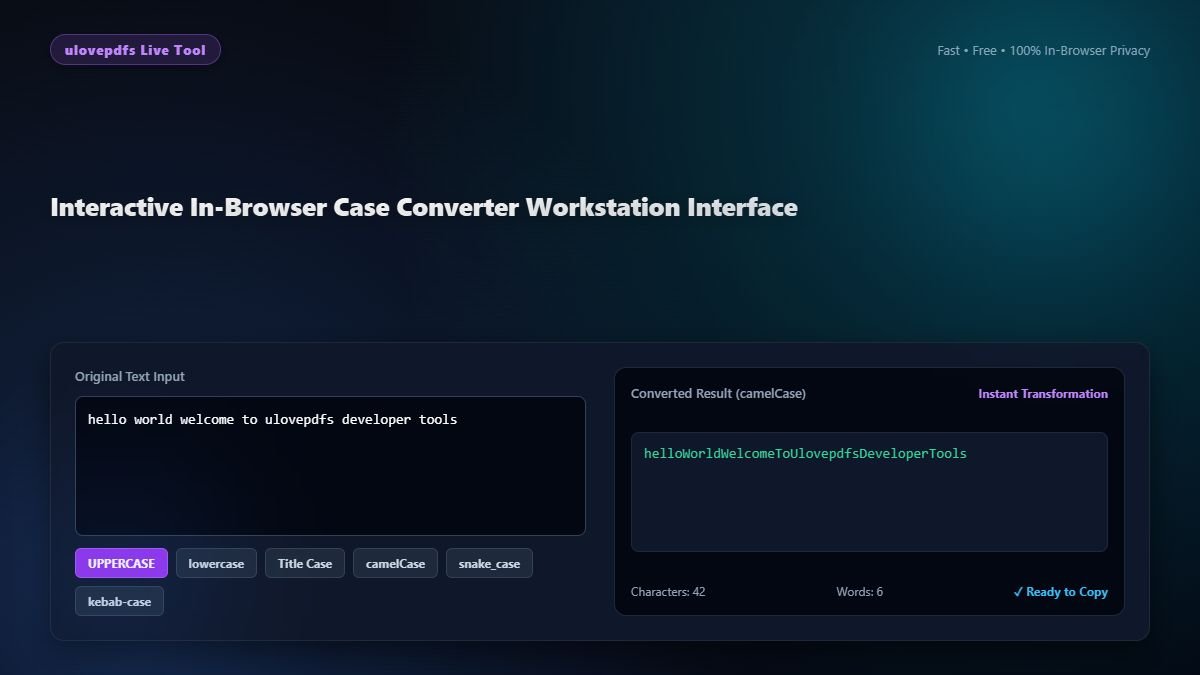
- Input Your Text: Open the free Case Converter workstation in any modern web browser. Paste or type your raw text, code snippet, or article headline into the primary input textarea.
- Select Your Desired Case Format: Click any of the dedicated conversion buttons: UPPERCASE, lowercase, Title Case, Sentence case, camelCase, PascalCase, snake_case, or kebab-case.
- Instant Real-Time Transformation: The Case Converter workstation immediately processes the text and displays the converted output in the results panel with real-time character and word count statistics.
- One-Click Clipboard Copy: Click the dedicated Copy to Clipboard button to copy your formatted string instantly, ready for pasting into your codebase, database query, or editorial document.
7. Developer Code Implementations: String Conversion in JavaScript and Python
For developers implementing string transformation routines in backend services or build automation scripts, here are clean, production-ready code examples across JavaScript and Python:
1. JavaScript (Regular Expression Case Transformers)
// Convert string to camelCase
function toCamelCase(str) {
  return str
    .replace(/[-_\s]+(.)?/g, (_, c) => c ? c.toUpperCase() : '')
    .replace(/^(.)/, c => c.toLowerCase());
}

// Convert string to snake_case
function toSnakeCase(str) {
  return str
    .replace(/([a-z0-9])([A-Z])/g, '$1_$2')
    .replace(/[-\s]+/g, '_')
    .toLowerCase();
}

// Convert string to kebab-case
function toKebabCase(str) {
  return str
    .replace(/([a-z0-9])([A-Z])/g, '$1-$2')
    .replace(/[_\s]+/g, '-')
    .toLowerCase();
}

// Example Executions
console.log(toCamelCase('User Profile Data')); // userProfileData
console.log(toSnakeCase('UserProfileData'));   // user_profile_data
console.log(toKebabCase('User Profile Data')); // user-profile-data
2. Python 3 (Regular Expression String Normalization)
import re

def to_snake_case(text: str) -> str:
    s = re.sub(r'([a-z0-9])([A-Z])', r'\1_\2', text)
    return re.sub(r'[-\s]+', '_', s).lower()

def to_camel_case(text: str) -> str:
    words = re.split(r'[-_\s]+', text)
    return words[0].lower() + ''.join(w.capitalize() for w in words[1:])

print(to_snake_case("UserProfileData")) # user_profile_data
print(to_camel_case("user_profile_data")) # userProfileData
3. Golang (Idiomatic Export Case Conversion)
package main

import (
	"fmt"
	"regexp"
	"strings"
)

// ToSnakeCase converts camelCase or PascalCase to snake_case
func ToSnakeCase(str string) string {
	matchFirstCap := regexp.MustCompile("(.)([A-Z][a-z]+)")
	matchAllCap := regexp.MustCompile("([a-z0-9])([A-Z])")
	snake := matchFirstCap.ReplaceAllString(str, "1_2")
	snake = matchAllCap.ReplaceAllString(snake, "1_2")
	return strings.ToLower(snake)
}

// ToPascalCase converts snake_case to exported PascalCase
func ToPascalCase(str string) string {
	parts := strings.Split(str, "_")
	for i, part := range parts {
		if len(part) > 0 {
			parts[i] = strings.ToUpper(part[:1]) + strings.ToLower(part[1:])
		}
	}
	return strings.Join(parts, "")
}

func main() {
	fmt.Println(ToSnakeCase("UserProfileData"))   // user_profile_data
	fmt.Println(ToPascalCase("user_profile_data")) // UserProfileData
}
4. PHP 8 (Multibyte & Regex Casing Transformers)
<?php

// Convert arbitrary string to camelCase
function toCamelCase(string $input): string {
    $clean = preg_replace('/[^a-zA-Z0-9]+/', ' ', $input);
    $words = ucwords(strtolower(trim($clean)));
    return lcfirst(str_replace(' ', '', $words));
}

// Convert string to kebab-case
function toKebabCase(string $input): string {
    $clean = preg_replace('/([a-z0-9])([A-Z])/', '$1-$2', $input);
    return strtolower(trim(preg_replace('/[^a-zA-Z0-9]+/', '-', $clean), '-'));
}

echo toCamelCase('user_profile_data'); // userProfileData
echo toKebabCase('UserProfileData');   // user-profile-data
?>
8. Full-Stack Architectural Friction: Solving Cross-Language Serialization Pitfalls
In distributed modern cloud architectures, serialization mismatches between frontend user interfaces and backend database engines represent one of the most persistent sources of developer friction. A modern full-stack application typically coordinates at least three distinct casing conventions across its network boundaries:
- Frontend Web & Mobile Clients (camelCase): The ECMAScript and TypeScript ecosystems overwhelmingly prefer camelCase for JSON object keys, React component state properties, and GraphQL response payloads.
- Microservices & Backend Controllers (snake_case): Python frameworks (Django, FastAPI), Ruby on Rails, and Rust backend services natively rely on snake_case for internal dictionaries, function signatures, and method parameters.
- Relational Database Engines (snake_case): PostgreSQL, MySQL, and MariaDB column definitions and schema tables conventionally utilize snake_case to ensure cross-platform ANSI SQL compatibility without requiring identifier quotes.
When these distinct layers communicate without automated normalization, subtle bugs emerge—such as undefined fields in frontend state or missing database values during ORM persistence. Modern serialization libraries provide automatic casing aliases, such as Pydantic’s alias_generator in Python or Jackson’s PropertyNamingStrategies.SNAKE_CASE in Java. However, during debugging, API testing, and manual mock data creation, developers rely on an interactive Case Converter to instantaneously harmonize conflicting object keys between backend and client tiers.
Integrating with Complementary Web Utilities on ulovepdfs
A precision Case Converter seamlessly connects with other essential web utilities available on ulovepdfs:
- Format Converted Data Payloads: Format your serialized camelCase and snake_case objects using our JSON Formatter.
- Encode Formatted Strings: Convert normalized text strings into URL-safe binary formats using our Base64 Encoder.
- Verify Text Length and Readability: Audit character limits and readability scores on converted editorial copy using our Word Counter.
- Calculate Mathematical Percentages: Compute growth metrics, discounts, and data ratios with our Percentage Calculator.
9. Frequently Asked Questions (FAQ) About Case Converter Tools
What is the difference between camelCase and PascalCase?
In camelCase (lower camel case), the very first letter of the string is lowercase, while subsequent words start with a capital letter (e.g., userProfile). In PascalCase (upper camel case), the first letter of the first word is also capitalized (e.g., UserProfile). An online Case Converter converts between both formats with a single click.
Why is kebab-case preferred for website URL slugs?
Major search engine algorithms specifically treat hyphens as natural word separators while treating underscores as alphanumeric connectors. Using kebab-case in URL slugs ensures that search crawlers parse individual keywords correctly for search engine rankings.
Can a Case Converter handle accented foreign letters?
Yes. Modern case conversion engines leverage Unicode case folding algorithms to preserve accents (such as é, ñ, and ü) without corrupting character encodings or stripping diacritical marks.
How does case conversion impact SQL collation and database performance?
In relational databases like MySQL and PostgreSQL, string comparison performance and index lookups depend on collation settings (such as utf8mb4_unicode_ci for case-insensitive or utf8mb4_bin for binary case-sensitive). Normalizing text to lowercase or snake_case before database insertion ensures that B-tree indexing operates deterministically without costly on-the-fly SQL LOWER() transformations.
What is the primary difference between Sentence case and Title Case?
Sentence case capitalizes only the first letter of the initial word and proper nouns, mirroring standard conversational prose. In contrast, Title Case capitalizes the primary nouns, verbs, pronouns, adjectives, and adverbs while retaining minor articles, prepositions, and coordinating conjunctions in lowercase according to AP or Chicago style manuals. Our Case Converter formats both styles accurately.
Is the ulovepdfs Case Converter safe for confidential source code?
Yes, 100%. Our tool runs completely within your local browser memory sandbox. No text or source code is ever sent across network connections, stored in remote databases, or logged to cloud servers.
Convert Text Cases Instantly in Your Browser
Transform text across uppercase, lowercase, camelCase, snake_case, kebab-case, and Title Case with instant zero-latency client-side privacy.
Open Free Case Converter →Written by editor
Full-stack engineer and privacy advocate at ulovepdfs, focusing on browser-native cryptography and high-performance client-side tooling.