

1. What is a BMI Calculator and Why is it Essential in 2026?
A reliable BMI Calculator is one of the most widely recognized, accessible, and clinically validated health assessment instruments in modern preventive medicine, personal fitness tracking, and public health epidemiology. Every year, hundreds of millions of individuals, personal trainers, registered dietitians, and clinical physicians worldwide turn to a BMI Calculator to obtain a standardized, objective screening metric for body weight relative to stature. Whether you are beginning a transformative weight-management journey, evaluating metabolic health risk horizons, or monitoring pediatric growth velocity, understanding the biometric output of an online BMI Calculator provides an essential baseline for lifelong wellness.
The term BMI stands for Body Mass Index, an anthropometric ratio originally formulated in 1832 by the Belgian polymath, astronomer, and statistician Adolphe Quetelet. Originally known as the Quetelet Index, this simple mathematical relationship between mass and stature was formally adopted in the late 20th century by international health authorities, including the World Health Organization (WHO), the Centers for Disease Control and Prevention (CDC), and the National Institutes of Health (NIH) as the universal international benchmark for categorizing nutritional status across adult populations.
In 2026, preventative digital healthcare is more vital than ever. Sedentary remote-work lifestyle patterns, hyper-palatable processed food environments, and fluctuating physical activity levels have amplified the global prevalence of metabolic conditions like hypertension, non-alcoholic fatty liver disease, and type 2 diabetes. Using an online BMI Calculator allows proactive individuals to assess their general weight classification within seconds, providing actionable feedback without requiring expensive clinical laboratory appointments or specialized calipers.
Through our dedicated in-browser BMI Calculator Tool, health-conscious users can toggle seamlessly between metric (centimeters and kilograms) and imperial (feet, inches, and pounds) units. Because our interactive workstation executes 100% locally within your browser sandbox, your personal biometric measurements, weight records, and physical parameters are completely private and never logged on remote cloud servers or shared with third-party advertisers.
2. Clinical Framework: Inside WHO Body Mass Index Classifications
To accurately interpret the numerical figure generated by a BMI Calculator, one must examine the international diagnostic thresholds established by the World Health Organization. The WHO organizes adult BMI scores into distinct categories that reflect statistical correlations with chronic disease morbidity and all-cause mortality.
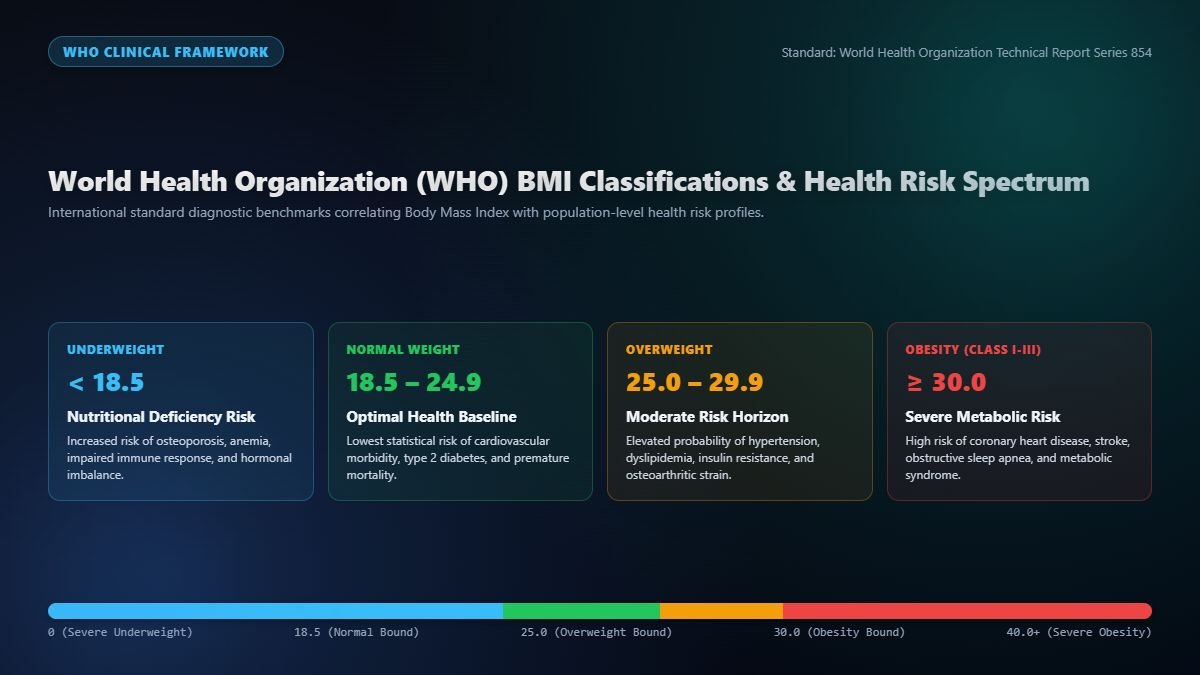
1. Underweight (BMI Less Than 18.5)
A score below 18.5 on a BMI Calculator indicates that an individual’s total body mass is lower than what is statistically optimal for their height. While some individuals are constitutionally lean due to genetics or high basal metabolism, chronic underweight status carries notable clinical risks: compromised immune function, micronutrient deficiencies, anemia, hormonal irregularities (such as amenorrhea in females), and accelerated bone mineral density loss predisposing to early-onset osteoporosis.
2. Normal Weight (BMI 18.5 to 24.9)
Often referred to as the “eutrophic” or optimal weight bracket, a reading between 18.5 and 24.9 on a BMI Calculator is associated with the lowest epidemiological incidence of chronic cardiovascular disease, stroke, metabolic syndrome, and premature mortality. Maintaining body mass within this range suggests an equilibrium between caloric intake, metabolic expenditure, and skeletal muscle mass.
3. Overweight (BMI 25.0 to 29.9)
A result falling between 25.0 and 29.9 on a BMI Calculator classifies an individual as overweight. In clinical epidemiology, this zone represents an inflection point where systemic vascular resistance, fasting blood glucose, and circulating LDL cholesterol often begin trending upward. While an overweight BMI does not guarantee active pathology, it indicates an elevated statistical probability of developing hypertension, osteoarthritis in weight-bearing joints, and subclinical insulin resistance.
4. Obesity Class I, II, and III (BMI 30.0 and Above)
When a BMI Calculator outputs a score of 30.0 or higher, the individual enters the clinical classification of obesity, subdivided into three progressive tiers:
- Class I Obesity (BMI 30.0 – 34.9): Moderate risk of coronary artery disease, elevated HbA1c, and hepatic steatosis.
- Class II Obesity (BMI 35.0 – 39.9): Severe risk category frequently accompanied by obstructive sleep apnea, gastroesophageal reflux disease, and chronic systemic inflammation.
- Class III Obesity (BMI 40.0 and Higher): Historically designated as extreme or morbid obesity, where risks of cardiovascular events, pulmonary hypertension, and metabolic failure increase exponentially.
3. The Mathematical Equations of Body Mass Index: Metric vs. Imperial Calculations
Behind the clean visual interface of our modern BMI Calculator lies an elegant mathematical formula. Understanding the underlying algebraic relationship between height and weight empowers users to calculate their score manually or verify automated outputs with precision.
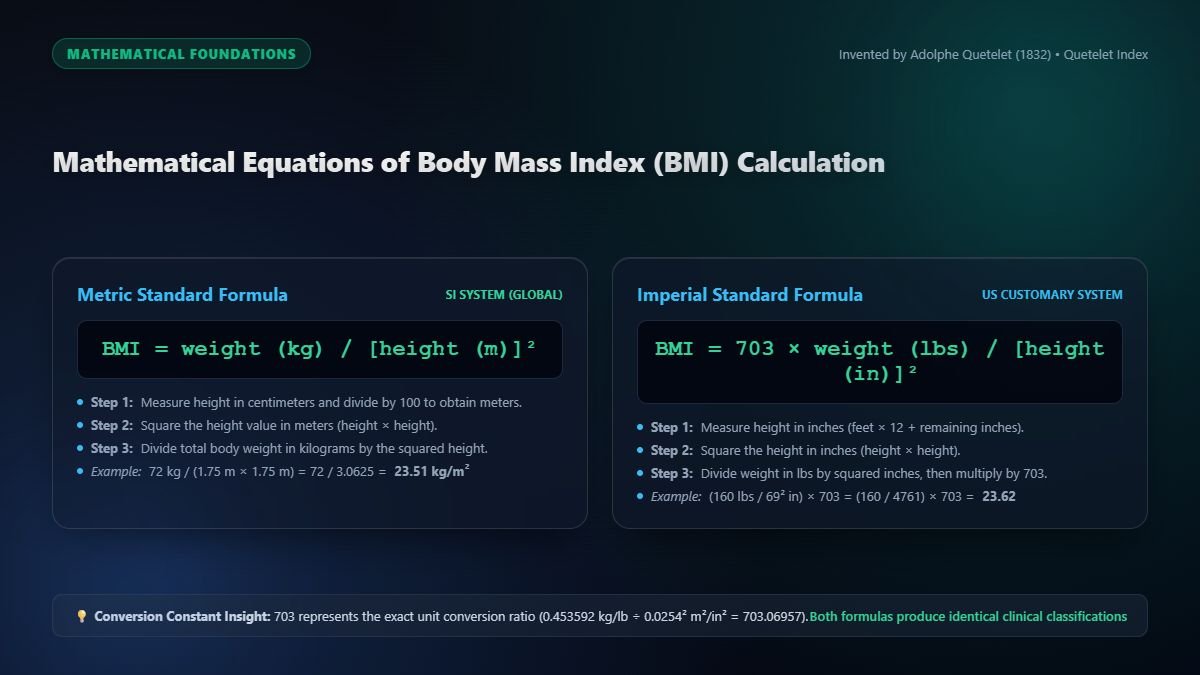
The Metric System Formula (SI Standard)
In the International System of Units (SI) utilized across the global scientific and medical communities, a BMI Calculator evaluates mass in kilograms divided by the square of height in meters:
Consider a practical clinical example: an adult weighing 72 kilograms with a height of 175 centimeters (1.75 meters):
- Square the height in meters:
1.75 × 1.75 = 3.0625 m² - Divide weight by squared height:
72 / 3.0625 = 23.51 kg/m² - The BMI Calculator returns 23.5, safely situated inside the Normal Weight classification.
The Imperial System Formula (US Customary)
For individuals in the United States and regions utilizing pounds and inches, a BMI Calculator applies a conversion factor of 703 to reconcile imperial units with metric equivalents:
Consider an individual weighing 160 pounds with a height of 5 feet 9 inches (69 inches total):
- Square height in inches:
69 × 69 = 4,761 in² - Divide weight by squared height:
160 / 4,761 = 0.033606 - Multiply by the conversion factor:
0.033606 × 703 = 23.62 - The BMI Calculator yields 23.6, perfectly matching the metric clinical diagnosis.
The conversion constant 703 represents the exact mathematical quotient of 0.45359237 kg/lb divided by 0.0254² m²/in², guaranteeing that our online BMI Calculator outputs mathematically identical results regardless of which unit toggle you select.
4. Body Mass Index vs. True Body Composition: What BMI Misses
While an online BMI Calculator serves as an exceptional, rapid, population-level screening tool, sophisticated health practitioners recognize that Body Mass Index has inherent anatomical limitations. Because the formula factors only gross weight and stature, a BMI Calculator does not distinguish between lean skeletal muscle mass, adipose fat tissue, bone mineral density, or extracellular fluid volume.
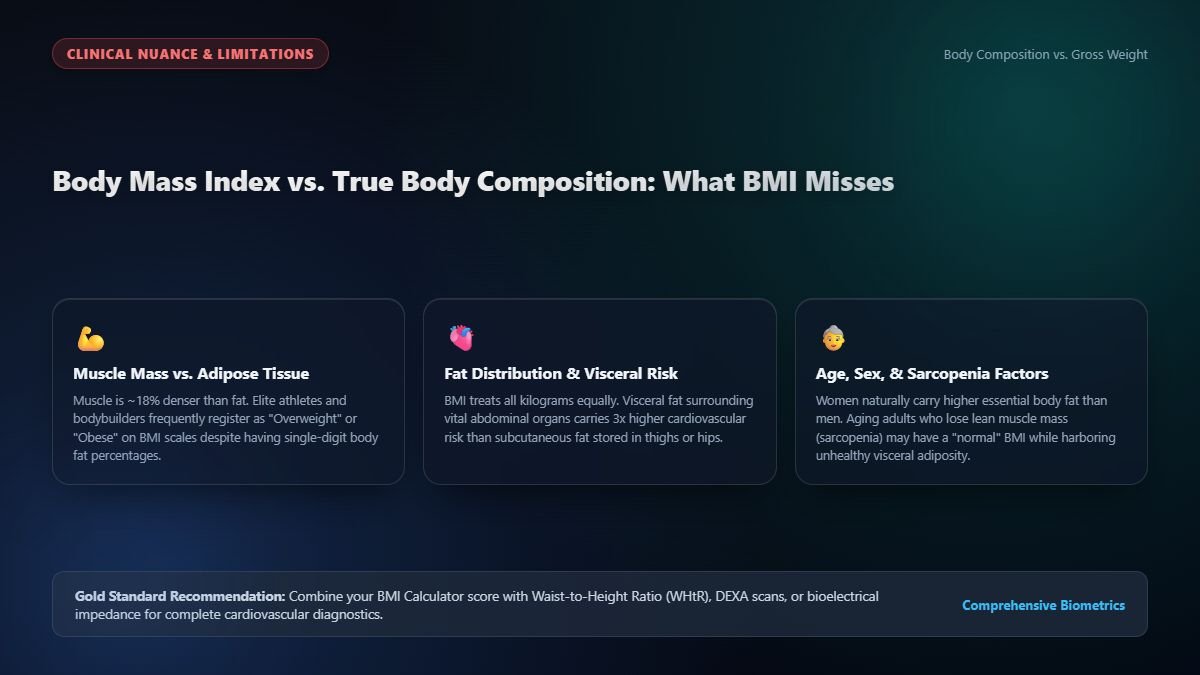
The Athlete Paradox: Skeletal Muscle Density
Muscle tissue is approximately 18% denser than adipose fat tissue. Highly trained athletes, competitive bodybuilders, rugby players, and CrossFit enthusiasts often possess low body fat percentages (8% to 12%) combined with significant muscular hypertrophy. When evaluated by a standard BMI Calculator, these muscular individuals frequently register an “Overweight” or even “Obese” score (e.g., BMI 28 to 32) despite having peak cardiovascular endurance and optimal metabolic biomarker profiles.
Visceral Adiposity vs. Subcutaneous Fat
A second critical blind spot of an unassisted BMI Calculator is fat distribution topography. Subcutaneous fat stored harmlessly beneath the skin on hips, thighs, and buttocks poses minimal cardiovascular risk. Conversely, visceral adipose tissue wrapped tightly around internal abdominal organs (the liver, pancreas, and intestines) releases pro-inflammatory cytokines and free fatty acids directly into the portal circulation. An individual can have a “Normal” score on a BMI Calculator while harboring hazardous levels of visceral abdominal adiposity—a clinical phenotype commonly termed “Normal-Weight Obesity” or “skinny fat.”
Age, Gender, and Sarcopenia Considerations
Human biological composition shifts naturally over the lifespan. Women biologically require higher essential body fat percentages (21% to 24%) than men (14% to 17%) to sustain normal endocrine and reproductive function. Furthermore, as adults age, age-related muscle loss (sarcopenia) can cause an older adult to lose significant lean tissue while accumulating body fat. A 70-year-old and a 20-year-old with the exact same 22.0 reading on a BMI Calculator will possess vastly different metabolic body composition profiles.
5. 9 Best Ways to Calculate, Track, and Interpret BMI in 2026
To maximize the clinical utility of an online BMI Calculator, health enthusiasts and clinical practitioners apply evidence-based protocols that enhance measurement fidelity and prevent reactionary misinterpretations. Below are the nine best ways to calculate, track, and contextualize your Body Mass Index in 2026:

1. Standardize Morning Weigh-In Conditions
Human body mass naturally fluctuates by 2 to 5 pounds over a single 24-hour cycle due to gastrointestinal transit, hydration levels, sodium intake, and glycogen replenishment. When inputting numbers into your BMI Calculator, always weigh yourself first thing in the morning, immediately after voiding your bladder and before consuming breakfast or water. Ensure your digital scale rests on a flat, hard, uncarpeted surface.
2. Measure Height Stadiometrically Without Footwear
Gravity compresses spinal intervertebral discs throughout the day, causing humans to shrink by 1 to 2 centimeters between morning waking and evening bedtime. For accurate results in a BMI Calculator, measure your stature barefoot in the morning standing against a flat vertical wall, with heels, buttocks, and upper back touching the surface while gazing straight forward along the Frankfort horizontal plane.
3. Pair BMI with Waist Circumference Measurements
The simplest way to overcome the anatomical limitations of a BMI Calculator is to cross-reference your score with waist circumference. Measuring waist circumference at the midpoint between the lowest rib and the iliac crest provides direct insight into visceral adiposity. According to clinical consensus, a waist circumference exceeding 40 inches (102 cm) in men or 35 inches (88 cm) in non-pregnant women signals heightened cardiometabolic danger, even if the BMI Calculator shows a borderline normal score.
4. Leverage Zero-Latency In-Browser Calculators
When tracking sensitive personal health data, privacy is paramount. Avoid cloud-hosted services that require email registration or store health records in external advertising databases. Utilizing a client-side BMI Calculator like ulovepdfs ensures that your weight, height, and health metrics are processed entirely within your device’s browser memory.
5. Track 4-Week Moving Averages Rather Than Daily Noise
A frequent psychological mistake among fitness beginners is obsessing over minor day-to-day fluctuations in their BMI Calculator score. Water retention from a high-sodium dinner, intense resistance training inflammation, or menstrual fluid shifts can temporarily elevate scale weight by several pounds. Plot your weekly readings and track a 4-week rolling average to visualize true biological fat loss or muscle gain trajectories.
6. Factor Athletic Muscle Mass and Resistance Training
If you engage in progressive heavy resistance training, powerlifting, or competitive bodybuilding, do not treat an “Overweight” score on a BMI Calculator as an immediate health catastrophe. Cross-reference your BMI with skinfold caliper measurements or bioelectrical impedance scales to verify whether the elevated mass is driven by functional skeletal muscle rather than excess adipose tissue.
7. Apply Pediatric CDC Percentile Curves for Children and Teens
Never apply standard adult WHO categories to children or teenagers aged 2 to 19. Because young bodies undergo dramatic hormonal, skeletal, and proportional shifts during puberty, a BMI Calculator for youths must interpret BMI values as age-and-sex-specific percentiles plotted against official CDC growth charts. A child is considered overweight only when their BMI reaches the 85th to 94th percentile for their specific age cohort.
8. Correlate BMI Readings with Comprehensive Blood Biomarkers
A score from a BMI Calculator is an initial screening indicator, not a definitive diagnosis. True metabolic health is defined by circulating systemic biomarkers: fasting glucose, HbA1c, triglycerides, HDL and LDL cholesterol ratios, resting blood pressure, and high-sensitivity C-reactive protein (hs-CRP). An individual with a BMI of 27 who exercises daily and possesses optimal lipid panels often exhibits far superior cardiovascular health than a sedentary individual with a BMI of 21.
9. Target Healthy Weight Ranges Rather Than an Arbitrary Single Number
Rather than fixating on achieving an arbitrary scale weight (such as exactly 150 lbs), configure your BMI Calculator to identify your healthy weight window. Because the “Normal Weight” BMI tier spans from 18.5 to 24.9, a 5’9″ adult has an optimal healthy weight range spanning nearly 44 pounds (from 125 lbs to 169 lbs). Aiming for a comfortable, sustainable weight bracket promotes long-term lifestyle adherence and avoids extreme, unsustainable crash diets.
6. Step-by-Step Guide: Using the ulovepdfs In-Browser BMI Calculator
Calculating your Body Mass Index with our interactive workstation is effortless, responsive, and completely private. Follow this simple four-step walkthrough to analyze your biometric profile in seconds:
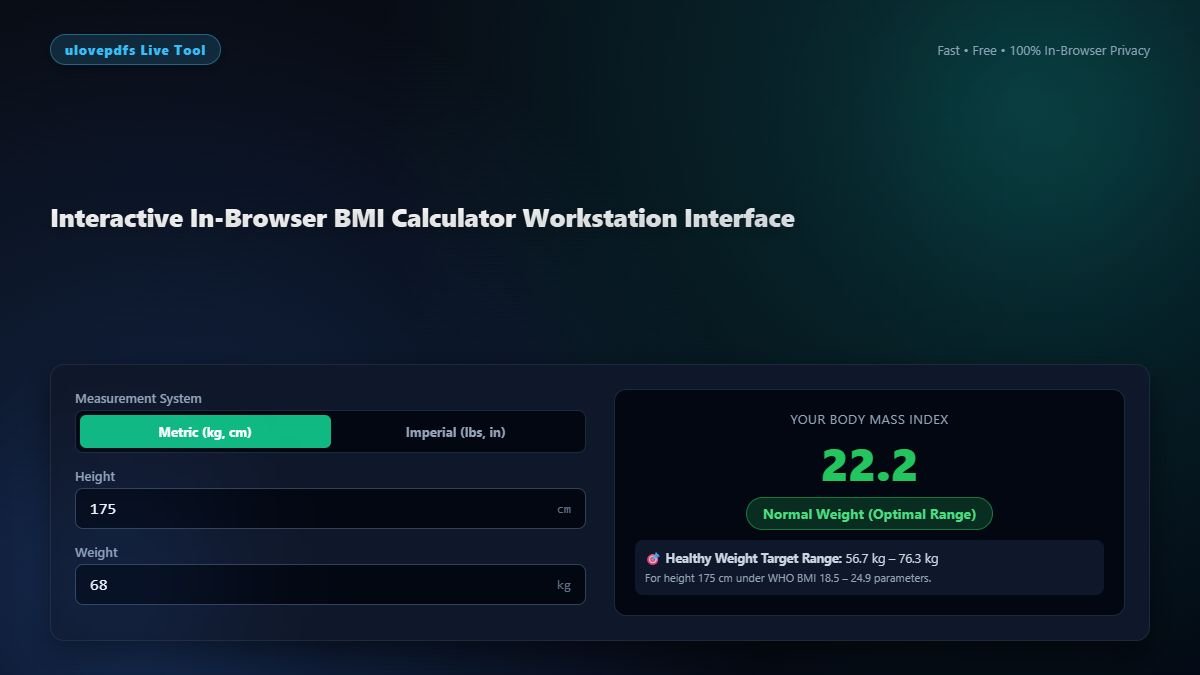
- Select Your Preferred Unit System: Open the free BMI Calculator in any modern browser. Click the unit toggle at the top of the interface to choose between Metric (centimeters and kilograms) or Imperial (feet, inches, and pounds).
- Enter Your Precise Stature: Enter your measured standing height into the height input field. In imperial mode, enter feet and remaining inches in separate designated boxes.
- Enter Your Current Weight: Input your morning scale weight into the weight field in kilograms or pounds.
- Instant Real-Time Diagnostic Analysis: The BMI Calculator workstation immediately calculates your Body Mass Index as you type. The tool displays your exact numerical BMI score, highlights your corresponding WHO clinical category (Underweight, Normal Weight, Overweight, or Obesity), and automatically outputs your personalized Healthy Weight Target Range.
7. Building a Holistic Health Stack: Complementary Web Utilities
In comprehensive personal wellness and quantitative self-tracking workflows, a BMI Calculator seamlessly integrates with other analytical utilities on ulovepdfs:
- Calculate Caloric Deficits and Metabolic Rates: Calculate percentage changes in scale weight, workout volume progression, and dietary macronutrient ratios using our fast Percentage Calculator. For deep insights on mathematical percentage changes, read our guide on percentage calculation techniques.
- Format Health Data Logs: Format exported Apple Health, Fitbit, or Garmin health telemetry records cleanly with our in-browser JSON Formatter.
- Analyze Fitness Journal Content: Track word counts, habit journal entries, and writing volume in personal fitness diaries using our Word Counter.
- Encode Biometric Data Tokens: Safely encode binary data payloads and health tokens for private staging using our client-side Base64 Encoder.
8. Developer Code Implementations: Calculating BMI in JavaScript and Python
For software developers building fitness web applications, telehealth dashboards, or mobile health apps, here are clean, production-ready code implementations for calculating BMI and categorizing WHO ranges:
1. JavaScript (Browser / Node.js)
function calculateBMI(weightKg, heightCm) {
  if (weightKg <= 0 || heightCm <= 0) {
    throw new Error('Weight and height must be positive numbers');
  }

  const heightM = heightCm / 100;
  const bmi = Number((weightKg / (heightM * heightM)).toFixed(1));

  let category = '';
  if (bmi < 18.5) category = 'Underweight';
  else if (bmi <= 24.9) category = 'Normal Weight';
  else if (bmi <= 29.9) category = 'Overweight';
  else if (bmi <= 34.9) category = 'Obesity Class I';
  else if (bmi <= 39.9) category = 'Obesity Class II';
  else category = 'Obesity Class III';

  // Calculate healthy weight bounds (18.5 to 24.9)
  const minWeight = Number((18.5 * heightM * heightM).toFixed(1));
  const maxWeight = Number((24.9 * heightM * heightM).toFixed(1));

  return { bmi, category, healthyRange: { minKg: minWeight, maxKg: maxWeight } };
}

// Example Execution
console.log(calculateBMI(68, 175));
// Output: { bmi: 22.2, category: 'Normal Weight', healthyRange: { minKg: 56.7, maxKg: 76.3 } }
2. Python 3
def calculate_bmi_imperial(weight_lbs: float, height_inches: float) -> dict:
    if weight_lbs <= 0 or height_inches <= 0:
        raise ValueError("Inputs must be strictly positive")

    bmi = round((703 * weight_lbs) / (height_inches ** 2), 1)

    if bmi < 18.5:
        category = "Underweight"
    elif bmi <= 24.9:
        category = "Normal Weight"
    elif bmi <= 29.9:
        category = "Overweight"
    else:
        category = "Obesity"

    return {"bmi": bmi, "category": category}

print(calculate_bmi_imperial(160, 69))
# Output: {'bmi': 23.6, 'category': 'Normal Weight'}
9. Frequently Asked Questions (FAQ) About BMI Calculator Tools
What is a healthy score on a BMI Calculator?
According to World Health Organization clinical standards, a healthy Body Mass Index for adults aged 20 and older ranges between 18.5 and 24.9 kg/m². Scores within this bracket correlate with the lowest statistical risk of chronic metabolic and cardiovascular complications.
Can a muscular person get an inaccurate result from a BMI Calculator?
Yes. Because a BMI Calculator measures only total weight without separating muscle from fat, lean athletes with substantial skeletal muscle mass can register an “Overweight” or “Obese” result. Muscular individuals should pair their BMI with waist-to-height ratio or skinfold body fat measurements.
How often should I use an online BMI Calculator?
Calculating your BMI once every two to four weeks is ideal for tracking long-term body composition trends. Checking daily is unnecessary because normal hydration shifts and digestive contents create minor day-to-day weight fluctuations that do not reflect true adipose tissue changes.
Does the ulovepdfs BMI Calculator save my personal data?
No. Our workstation runs 100% locally within your client browser memory using client-side JavaScript. Not a single byte of your height, weight, or biometric results is transmitted across the internet, logged to remote databases, or shared with third parties.
Calculate Your Body Mass Index Instantly
Assess your clinical weight category, discover your ideal healthy weight target range, and monitor biometric progress with 100% in-browser privacy.
Open Free BMI Calculator →Written by editor
Full-stack engineer and privacy advocate at ulovepdfs, focusing on browser-native cryptography and high-performance client-side tooling.